

A Practical Guide to SMAS vs Deep Plane Facelift
September 28, 2026
SMAS vs Deep Plane Facelift: The Quick Comparison
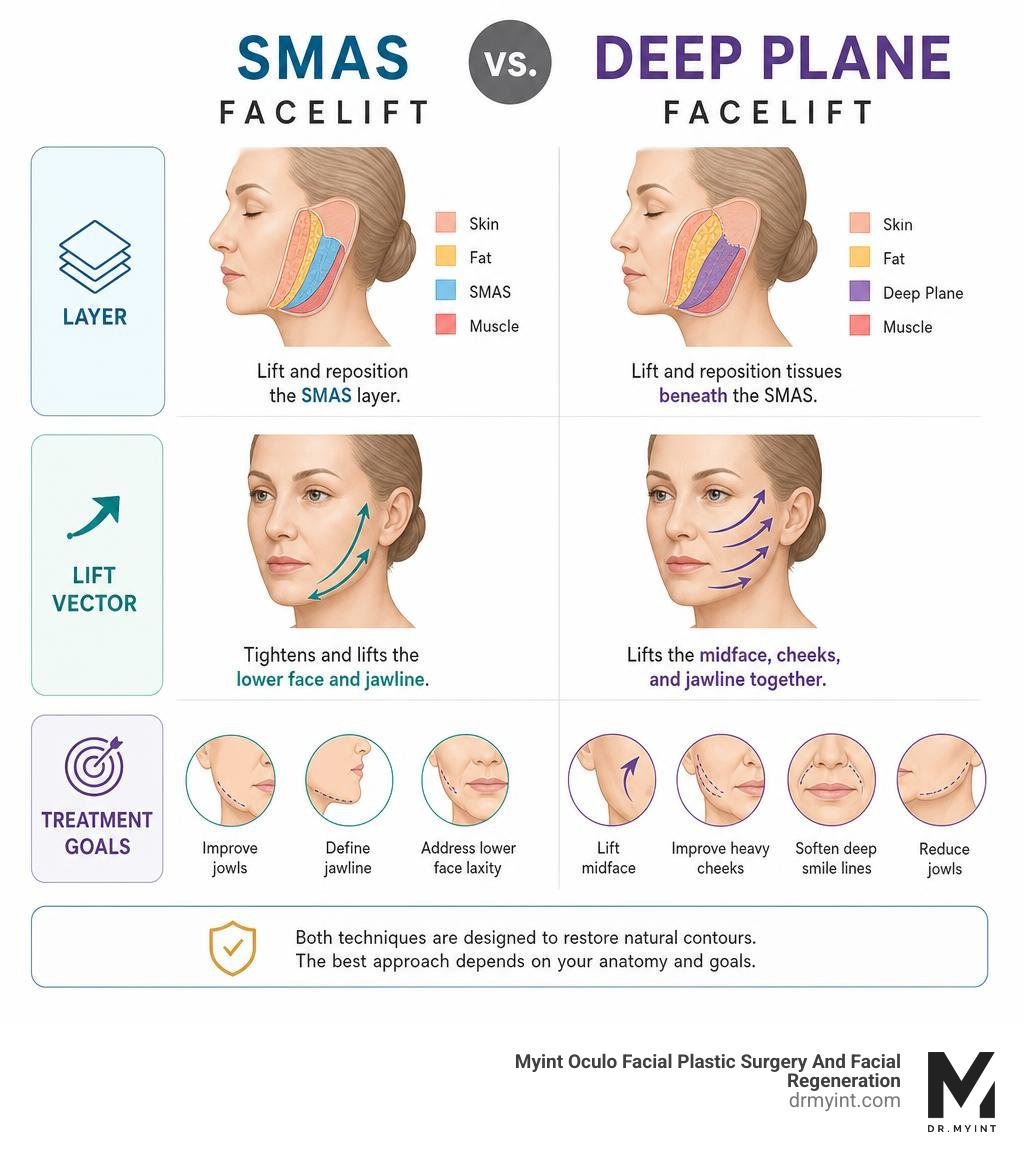
SMAS vs deep plane facelift comes down to the facial layer your surgeon lifts and the areas of aging that need the most support. Both are modern surgical facelifts designed to restore a natural facial contour, rather than simply pulling the skin tighter.
| Feature | SMAS Facelift | Deep Plane Facelift |
|---|---|---|
| Main treatment layer | The SMAS, a supportive layer beneath the skin | Beneath the SMAS, in a deeper natural tissue plane |
| Best-known strengths | Jowls, jawline laxity, and lower-face aging | Midface descent, heavier cheeks, jowls, and deep smile lines |
| How tissue is moved | The SMAS is tightened, folded, repositioned, or partially removed | The cheek and jowl tissues are released and elevated together |
| Technical demands | Highly effective, with several surgical variations | More complex dissection and precise release of retaining ligaments |
Neither approach is automatically “better.” A deep plane facelift can be especially useful when sagging begins in the cheeks and midface, while an SMAS approach may be an excellent fit for people whose main concerns are lower-face laxity, jowls, and jawline definition. Both procedures can deliver strong outcomes when the technique matches the patient’s anatomy, goals, and surgical plan.
I am Dr. Shoib Myint, a board-certified, fellowship-trained oculo-facial plastic and reconstructive surgeon with extensive experience performing surgeries around the eyes, face, and neck. In discussing SMAS vs deep plane facelift options, I focus on careful anatomy, safety, and results that look balanced rather than overdone.
Key Anatomical Differences in SMAS vs Deep Plane Facelift Procedures
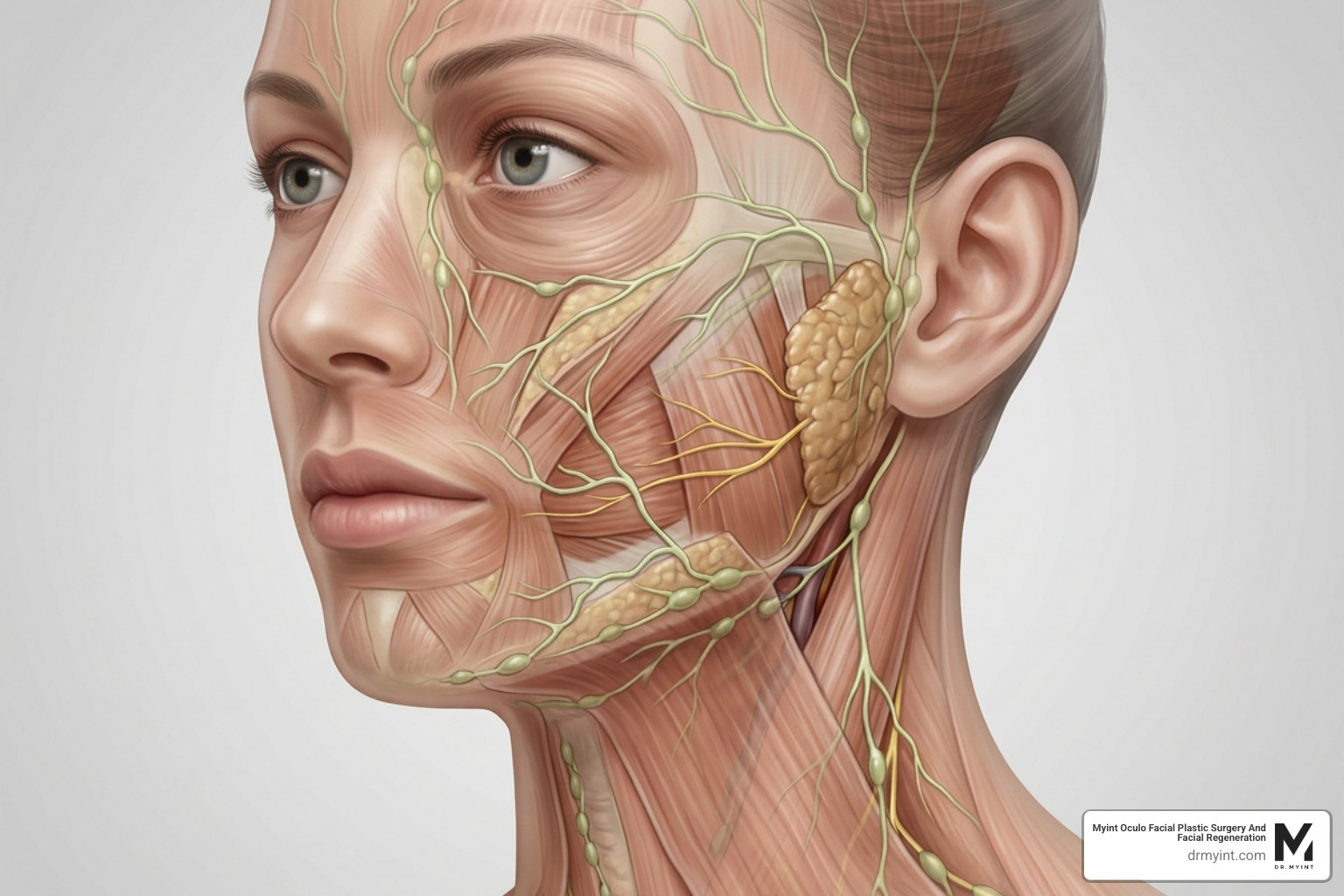
To truly understand how facial rejuvenation works, we must first look under the skin. The face is composed of several distinct anatomical layers: skin, subcutaneous fat, the superficial musculoaponeurotic system (SMAS), sub-SMAS deep space, and periosteum (bone covering).
The SMAS is a continuous fibrous and muscular network that links your facial muscles to the overlying soft tissues. As we age, gravitational forces, tissue atrophy, and ligament laxity cause this entire structural framework to shift downward and inward.
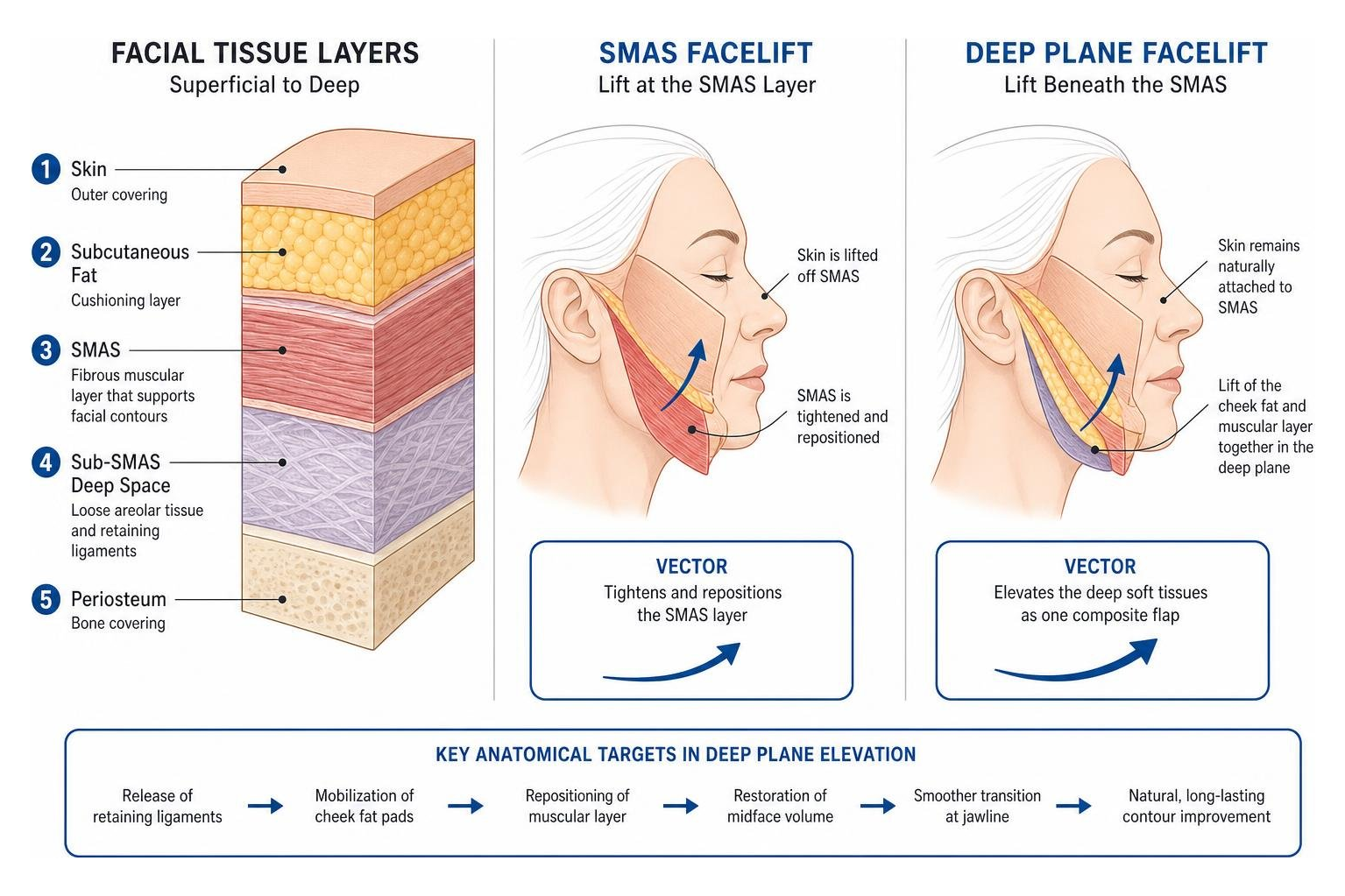
When evaluating a SMAS vs deep plane facelift, the critical anatomical difference lies in whether the surgeon elevates the SMAS away from the skin or enters the sub-SMAS plane beneath it.
In a traditional SMAS procedure, we separate the skin from the underlying SMAS layer across the cheek. We then tighten or reposition the SMAS itself. In contrast, a deep plane facelift goes beneath the SMAS layer entirely. By operating in the deep structural plane, we leave the skin naturally attached to the SMAS. This allows us to lift the skin, fat pads, and muscular layer as one unified composite flap without pulling or stretching the delicate outer skin.
Key Anatomical Targets in Deep Plane Elevation
The true technical secret of a deep plane facelift is the release of facial retaining ligaments. These fibrous tethering points (such as the zygomatic and masseteric retaining ligaments) act like anchor ropes holding the midface soft tissues down to the underlying facial bone.
During a deep plane elevation, we precisely release these retaining ligaments. Once liberated, the overlying cheek fat pad (malar fat pad) and zygomaticus muscle complex can move freely. This enables us to vertically reposition the heavy tissues of the midface back to their youthful location over the cheekbones without creating unnaturally tight skin tension.
How SMAS vs Deep Plane Facelift Variations Address Soft Tissue
The SMAS technique is not just a single procedure, but rather a family of customized variations:
- SMAS Plication: We fold and suture the SMAS layer onto itself to add volume and firm the lower face.
- SMAS Imbrication: We trim an edge of the SMAS layer and overlap the remaining tissue for a firmer anatomical anchor.
- SMASectomy: We excise a strip of excess SMAS tissue in areas of maximal laxity, securing the edges tightly.
While these SMAS modifications work wonderfully for tightening the lower jawline and upper neck, they do not release the deep retaining ligaments of the upper cheek. In contrast, the sub-SMAS dissection of a deep plane lift reshapes the cheek and jowl complex simultaneously. When analyzing the smas vs deep plane facelift dynamic, the choice rests on whether your facial structure requires ligament release or surface-level structural tightening.
Clinical Outcomes: Longevity and Rejuvenation Efficacy
Patients frequently ask us which procedure yields superior aesthetic results. The most useful answer depends less on a universal ranking and more on the patient’s anatomy, degree of tissue descent, and goals for cheek, jawline, and neck rejuvenation.
| Clinical Parameter | SMAS Facelift Techniques | Deep Plane Facelift |
|---|---|---|
| Primary Vector of Lift | Lateral / Diagonal | Vertical / Supero-lateral |
| Midface & Cheek Elevation | Moderate | Substantial |
| Soft Tissue Tension Location | SMAS layer & outer skin | Deep retaining ligament structures |
| Incision Stress & Scar Quality | Variable skin tension | Low skin tension; fine, hidden scars |
Addressing Jowls and Midface Descent with SMAS vs Deep Plane Facelift Options
Jowls and deep nasolabial folds (smile lines) are among the most common reasons patients seek facial rejuvenation at our practice in Las Vegas and Beverly Hills.
Because jowls are formed by sagging midface fat and lower facial tissue laxity, how we elevate those tissues dictates your final appearance:
- SMAS Facelift Approach: Tightens the lower face effectively, reducing mild-to-moderate jowling along the jawline. However, because it does not release deep midface ligaments, it has a limited impact on deep nasolabial folds or fallen cheek volume.
- Deep Plane Facelift Approach: By releasing the zygomatic and masseteric ligaments, we lift the origin of the jowl and cheek descent. This restores full cheek volume, softens deep smile lines, and creates a crisp, smooth jawline without artificial tightness.
When selecting between a smas vs deep plane facelift, patients with prominent midface flatting or severe jowl formation often achieve more harmonious rejuvenation with the deep plane strategy.
Evaluating Longevity Across Both Surgical Techniques
How long will a facelift last? That is a fundamental question for every patient. Both SMAS and deep plane facelifts are designed to provide durable rejuvenation, especially when paired with healthy skin quality, stable weight, and a surgical plan matched to the patient’s anatomy.
However, because a deep plane lift releases deep facial anchors and redistributes tension beneath the skin, the mechanical burden is carried by sturdy sub-SMAS tissue rather than delicate dermal layers. This structural balance helps results age with natural elegance. We invite you to explore our insights on why deep plane facelifts produce natural outcomes.
Safety Profiles and Surgical Complexity
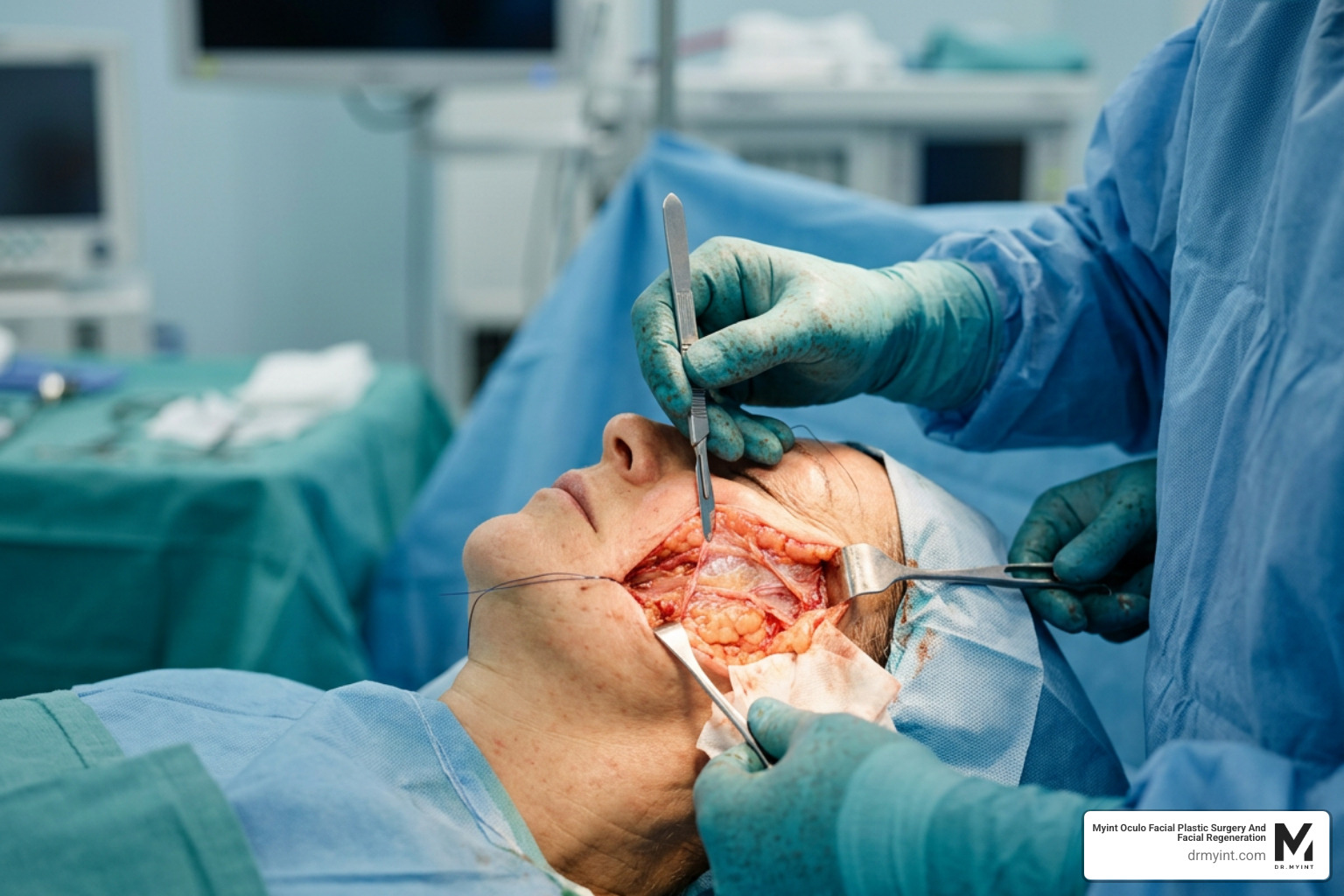
Safety is our absolute priority in any surgical endeavor. Modern facial plastic surgery requires careful patient selection, precise technique, and a surgeon with deep familiarity with facial anatomy.
While deep plane dissection demands advanced anatomical expertise, the key for patients is choosing a specialist who understands how to work around delicate facial structures while maintaining natural tissue support. We cover these surgical nuances in detail in our breakdown of why deep plane facelifts compare favorably to standard SMAS options.
Recovery Timelines and Candidate Selection for Surgical Success

Understanding what to expect during your healing journey helps ensure a smooth, confident recovery. While individual healing responses vary, comparing post-operative recovery patterns between techniques gives patients realistic expectations.
You can read a comprehensive guide on post-operative milestones in our article detailing what to expect before and after a facelift.
Candidate Profiling: Skin Elasticity, Age, and Facial Structure
Selecting the right operation comes down to your personal anatomy, facial aging pattern, skin elasticity, and aesthetic goals.
Ideal Candidates for an SMAS Facelift:
- Patients with mild-to-moderate skin laxity.
- Individuals whose main aging concerns are located along the lower jawline, neck, and lower jowls.
- Patients with good midface cheek volume who do not require significant elevation of deep smile lines.
- Individuals seeking an effective rejuvenation with minimal surgical complexity.
Ideal Candidates for a Deep Plane Facelift:
- Patients with moderate-to-severe tissue descent.
- Individuals exhibiting heavy jowls, drooping cheek volume, and deep nasolabial folds.
- Patients with heavier facial tissue who require strong structural release to achieve elevation.
- Patients desiring maximum longevity and midface rejuvenation without tension on the skin.
For a deeper dive into these technical differences, see our resource on how a deep plane facelift differs from a regular facelift.
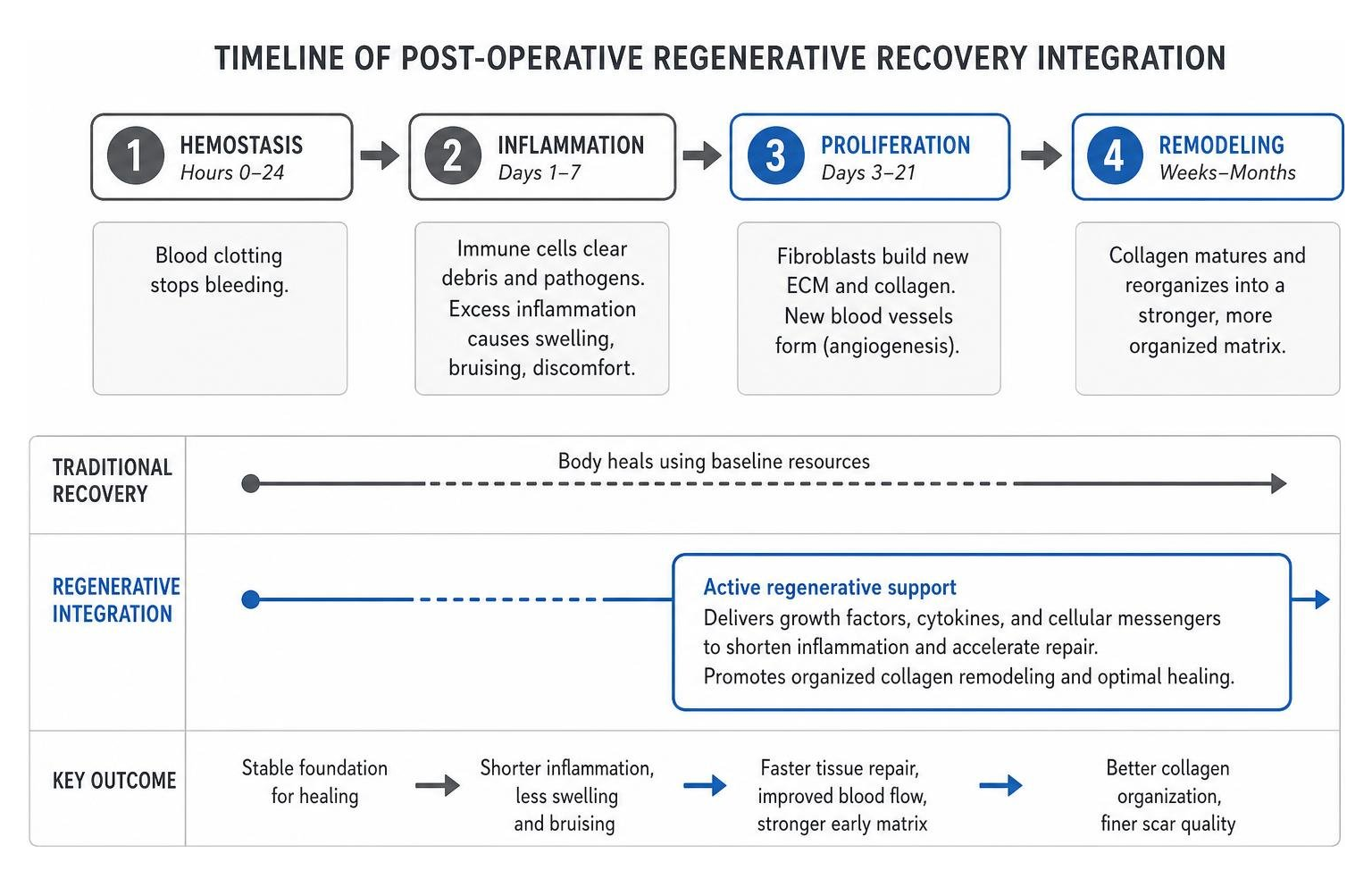
Accelerating Healing with Regenerative Medicine
At Myint Oculo Facial Plastic Surgery And Facial Regeneration, we do not simply perform surgical elevation; we prioritize advanced post-operative healing. Our practice integrates cutting-edge regenerative medicine techniques alongside surgical procedures to optimize recovery quality.
Regenerative facial care can support post-surgical healing by encouraging healthy tissue recovery, helping calm swelling, and supporting collagen renewal around delicate facial incisions. When paired with careful surgical planning and attentive aftercare, these supportive therapies can help patients feel more comfortable and confident during recovery.
By pairing precise sub-SMAS surgical restoration with cellular-level regenerative therapies, our patients in Nevada and California can experience a smoother, more supported healing process.
Frequently Asked Questions About SMAS and Deep Plane Facelifts
Which procedure provides higher overall patient satisfaction?
Both SMAS and deep plane facelifts can provide high patient satisfaction when chosen for the right anatomy and goals. Deep plane techniques are often favored for patients who need meaningful cheek elevation, softening of deep nasolabial folds, and jowl improvement without a tight or pulled skin appearance. SMAS procedures remain valuable for patients focused primarily on jawline and lower-face rejuvenation.
How do recovery times differ between SMAS and deep plane facelifts?
Social downtime for both procedures is often similar, with many patients feeling comfortable returning to work and social activities after the early swelling and bruising phase improves. Because a deep plane facelift lifts tissue as a single, thick skin-SMAS unit without separating skin from fat over a wide surface, skin microcirculation is preserved. This may help reduce surface bruising, although deeper tissue swelling can take longer to fully settle.
Are incision patterns different between deep plane and SMAS lifts?
The incision patterns for both SMAS and deep plane facelifts are very similar. Incisions are carefully hidden along the natural curves of the ear cartilage (periauricular), starting in the hairline above the ear, tracing inside the tragus, wrapping around the earlobe, and extending into the lower scalp line. Because a deep plane facelift places minimal tension on the skin edges, deep plane incisions are designed to heal as discreetly as possible.
Choosing Your Facial Rejuvenation Path
Deciding between a smas vs deep plane facelift is a deeply personal journey that depends on your individual facial structure, degree of tissue laxity, and personal aesthetic goals. Neither technique is universally superior for every individual; rather, the best choice is the one tailored specifically to your unique anatomical needs by an experienced specialist.
At Myint Oculo Facial Plastic Surgery And Facial Regeneration, Dr. Shoib Myint brings rare dual-fellowship training and over two decades of surgical expertise to every patient consultation across our Las Vegas, NV, and Beverly Hills, CA locations. Our practice blends high-precision sub-SMAS anatomical restoration with advanced regenerative therapies to deliver youthful, natural results that age beautifully.
If you are considering facial rejuvenation and want to discover the optimal approach for your face, we invite you to learn more about our Deep Plane Facelift procedures or schedule your private, personalized consultation with our team today.