

How a Facelift Can Correct Jowls: A Practical Guide
August 26, 2026
Why Jowls Are the #1 Lower Face Aging Concern
Jowls, the sagging, drooping skin along the jawline that blurs what was once a clean, defined angle from ear to chin, are one of the most common reasons adults in their 40s, 50s, and 60s seek facial rejuvenation.
Here’s a quick answer to what you need to know:
| Question | Quick Answer |
|---|---|
| What causes jowls? | Loss of collagen, weakened retaining ligaments, and fat pad descent |
| Best surgical fix? | Deep plane facelift, which addresses the root cause and lasts 10-15 years |
| Best non-surgical option? | Dermal fillers + thread lifts, which are temporary and last 1-2 years |
| Who is a good candidate? | Adults in good health with mild to severe lower face laxity |
| Recovery time? | 1-2 weeks back to work; full recovery in 4-6 weeks |
| Average cost? | Facelift starts around $8,000-$15,000+ depending on technique |
Jowls are not just a skin problem. They’re the visible result of multiple structural changes happening beneath the surface, with bone, fat, muscle, and ligaments all playing a role. That’s why no single cream or quick fix truly corrects them.
The good news? Modern surgical techniques, especially the deep plane facelift, now address the root cause of jowling rather than simply pulling skin tight. Results look natural, and they last.
I’m Dr. Shoib Myint, a board-certified, fellowship-trained Oculo Facial Plastic and Reconstructive Surgeon with over 20 years of experience and more than 15,000 surgeries performed, including deep plane facelifts specifically designed to correct jowls with natural, lasting results. In this guide, I’ll walk you through everything you need to make a confident, informed decision about your jawline.
Understanding Jowls: Why Our Jawlines Sag as We Age
To understand how to get rid of jowls, we first need to look at what they actually are. Interestingly, the word “jowl” is not a formal medical term. It actually comes from the Middle English word cholle, which refers to the fullness and looseness of the flesh under the lower cheek and jaw.
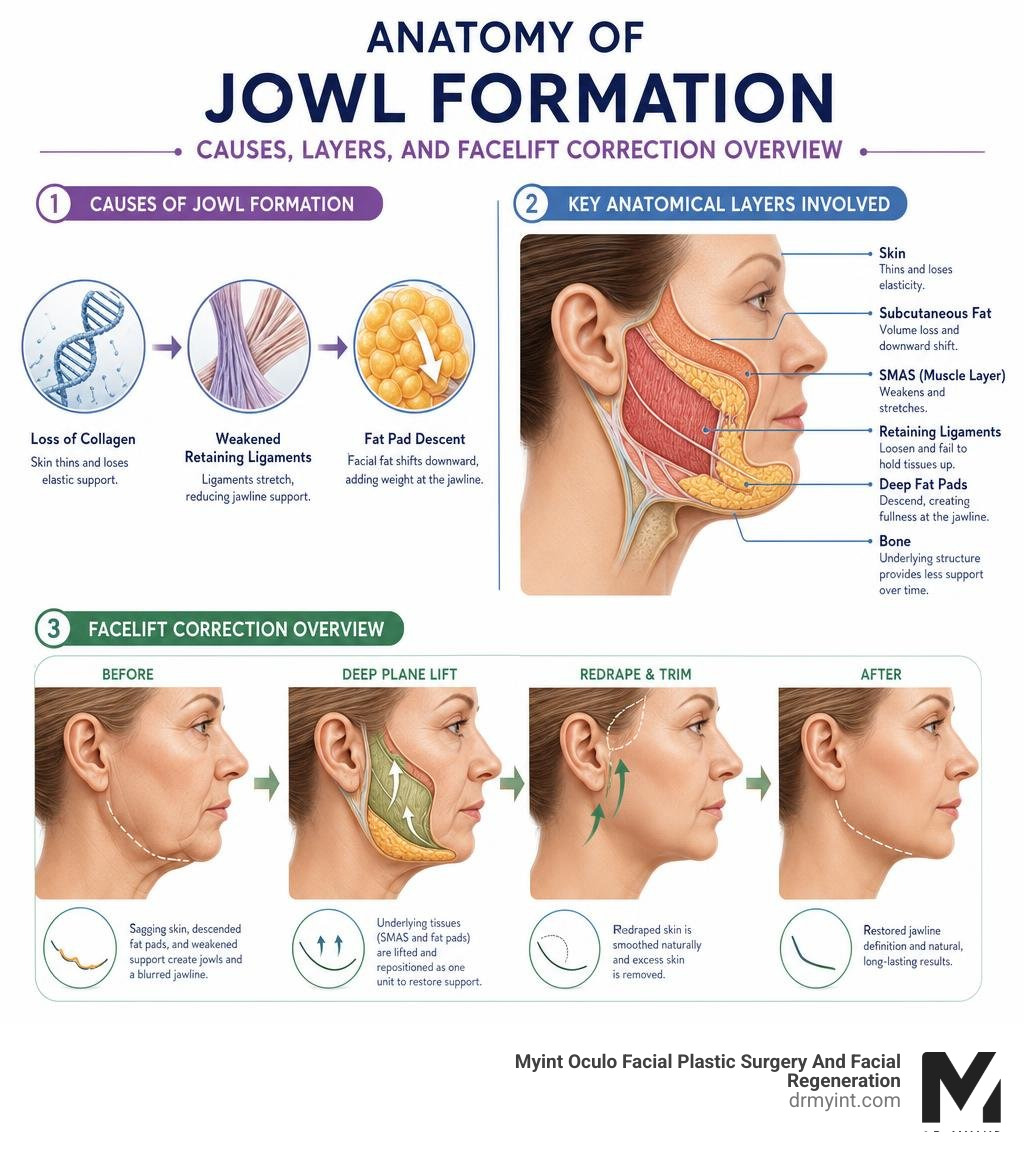
In clinical terms, jowling represents the descent of soft tissues below the border of the mandible (jawbone). As we age, several anatomical changes occur in harmony to cause this sagging:
- Collagen and Elastin Decline: Starting in our 30s, our skin’s natural production of collagen (the protein that provides structural support) and elastin (the protein that allows skin to snap back) slows down. The remaining collagen fibers become more disorganized and jumbled, leading to thinner, weaker skin that is highly susceptible to gravity.
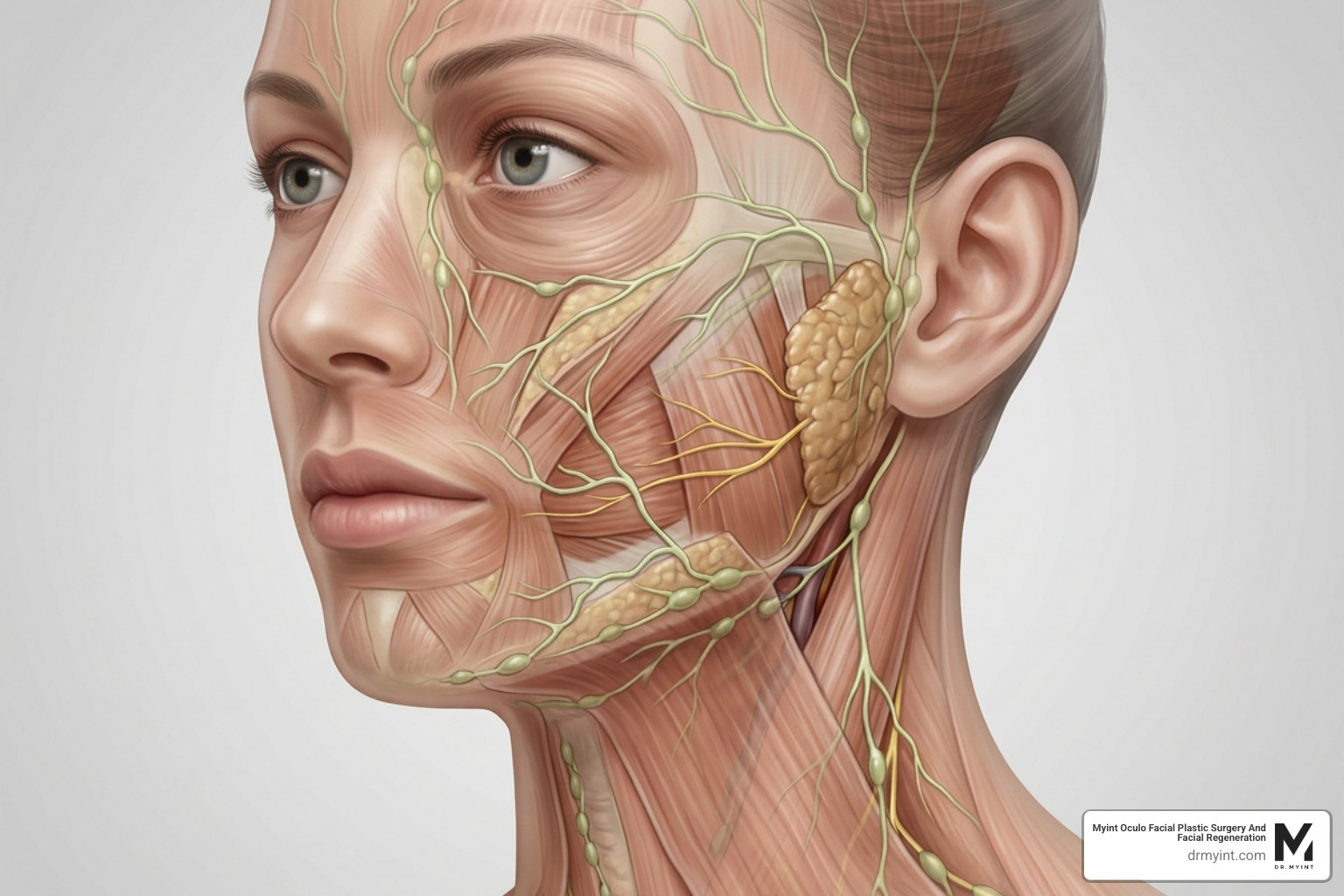
- Weakening of Retaining Ligaments: The face has structural “anchor points” called retaining ligaments, specifically the mandibular and masseteric ligaments, which secure the facial tissues to the underlying bone. As these ligaments stretch and weaken, they can no longer hold the overlying fat and skin in place.
- Descent of Facial Fat Pads: The youthful face is characterized by well-positioned fat pads that give the cheeks volume. As ligaments weaken, the buccal and pre-mandibular fat pads slide downward and forward, pooling along the jawline to create the classic heavy, drooping appearance of jowls.
- Platysma Muscle Laxity: The platysma is a thin, flat sheet of muscle extending from the lower face, down the jawline, and into the neck. Over time, the platysma muscle loses its tone, and its fibers pull downward on the corners of the mouth and the jawline, worsening the appearance of jowls.
- Bone Resorption: As we grow older, we naturally lose bone density in our jaw (mandibular bone resorption). This reduces the structural “scaffold” that keeps the skin of the lower face taut.
- The Modern Trigger (GLP-1 Weight Loss): In recent years, we have seen a dramatic rise in patients seeking treatment for “Ozempic face.” Rapid weight loss from GLP-1 agonist medications causes sudden facial volume loss. Because the skin envelope cannot shrink quickly enough to match this rapid deflation, the remaining tissues sag rapidly, accelerating jowl formation even in younger patients.
To learn more about how these changes affect the lower face over time, you can read the latest Scientific research on lower face aging.
Surgical Correction: How a Facelift Treats Jowls
When sagging is moderate to severe, surgical correction is the absolute gold standard for restoring a sharp, youthful jawline. A lower facelift (medically known as a rhytidectomy) is specifically designed to target the lower third of the face and the upper neck.
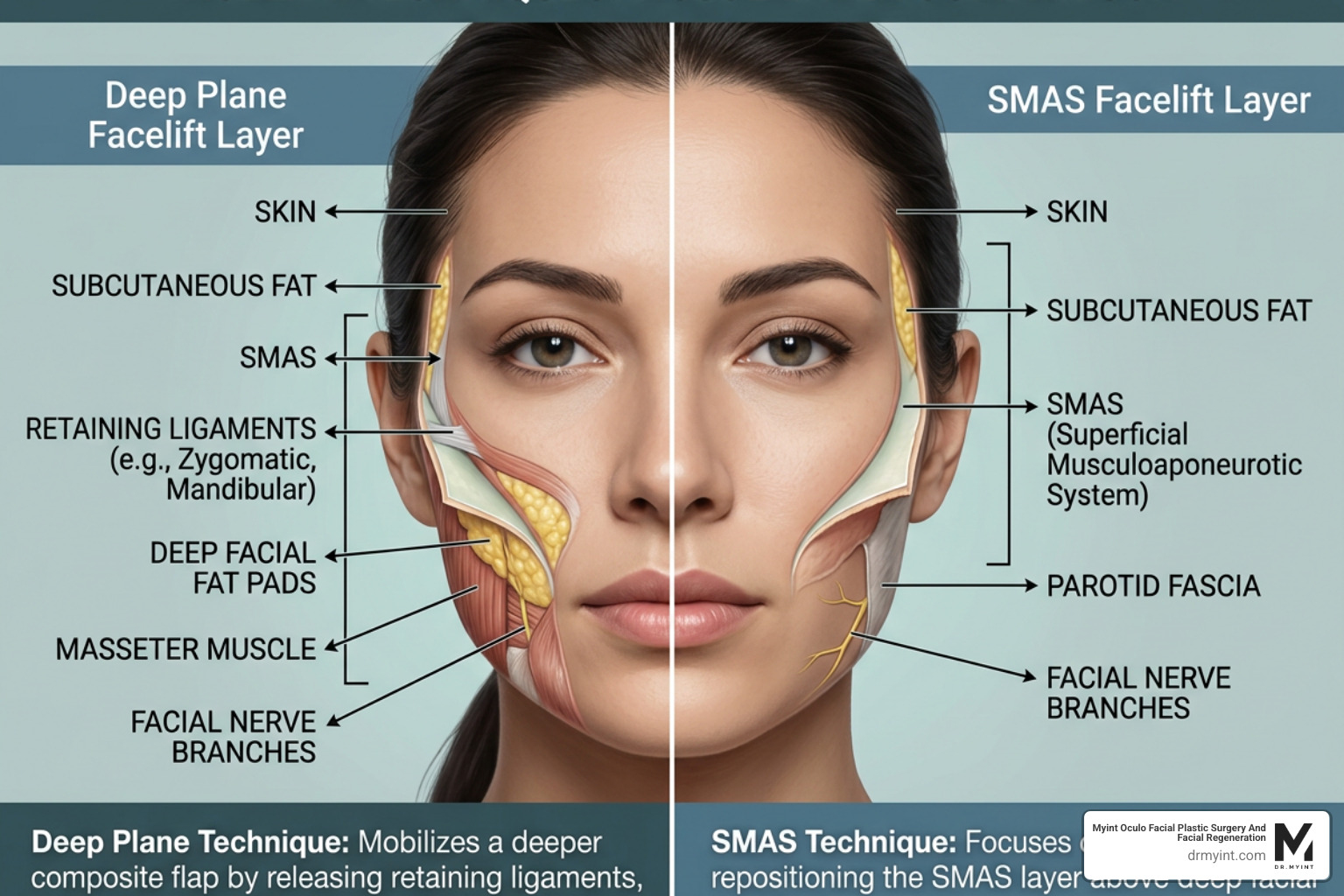
During a standard lower facelift, we do not simply pull the skin backward, as older, outdated techniques did. Pulling only the skin results in a tight, windswept, and highly unnatural “pulled” look. Instead, modern facial plastic surgery focuses on the SMAS (Superficial Musculoaponeurotic System) layer.
The SMAS is a deep, fibrous tissue layer that connects your facial muscles to your skin. By targeting this deeper layer, we can lift and tighten the structural foundation of the face. Here is how a lower facelift is typically performed:
- Incision Placement: Incisions are meticulously placed within the natural creases around the front of the ear, wrapping around the earlobe, and extending into the hairline behind the ear. This makes the resulting scars virtually invisible once fully healed.
- SMAS Mobilization: We elevate the skin slightly to access the SMAS layer. The deep tissues, fat pads, and muscles are then lifted and repositioned to their original, youthful position.
- Redundant Skin Removal: Once the structural foundation is securely lifted, the overlying skin is draped naturally over the new contour. The excess, sagging skin is carefully trimmed away.
- Suture Closure: The incisions are closed with minimal tension to prevent wide scars and avoid distorting the earlobe shape.
For a detailed breakdown of the specific structures addressed during this surgery, read our article on More details on lower facelift correction.
Mini Facelift vs. Full Facelift for Jowls
Many patients ask if they can achieve their goals with a less invasive “mini” facelift rather than a full facelift. The choice depends entirely on your anatomy, age, and the severity of your jowling.
A mini facelift (often called a short-scar facelift) is an excellent option for patients in their late 30s to early 50s who are experiencing early, mild-to-moderate jowling with minimal neck sagging.
- The Procedure: It utilizes shorter incisions (typically ending at the earlobe rather than wrapping behind the ear) and focuses primarily on the lower cheeks and jawline.
- The Benefits: It offers about half the recovery time of a traditional facelift, with patients often returning to work in about a week. The results of a mini facelift typically last around ten years.
- The Limitations: A mini facelift cannot address significant neck laxity (“turkey neck”) or severe, heavy jowls.
A full lower facelift is required when there is moderate-to-severe skin redundancy along both the jawline and the neck. This comprehensive approach rejuvenates the face by ten to 15 years and maintains its lasting effects for a similar timeframe.
If you are wondering which option is right for your early signs of aging, explore our guide: Can a mini facelift tighten jowls?.
Why Deep Plane Facelift Surgery Is Superior for Jowls
While standard SMAS facelifts are highly effective, the deep plane facelift is widely considered the absolute gold standard for correcting jowls.
In a traditional SMAS facelift, the skin is separated from the underlying SMAS layer, and the SMAS is pulled and stitched. In a deep plane facelift, we do not separate the skin from the SMAS. Instead, we enter a natural anatomical plane beneath the SMAS layer.
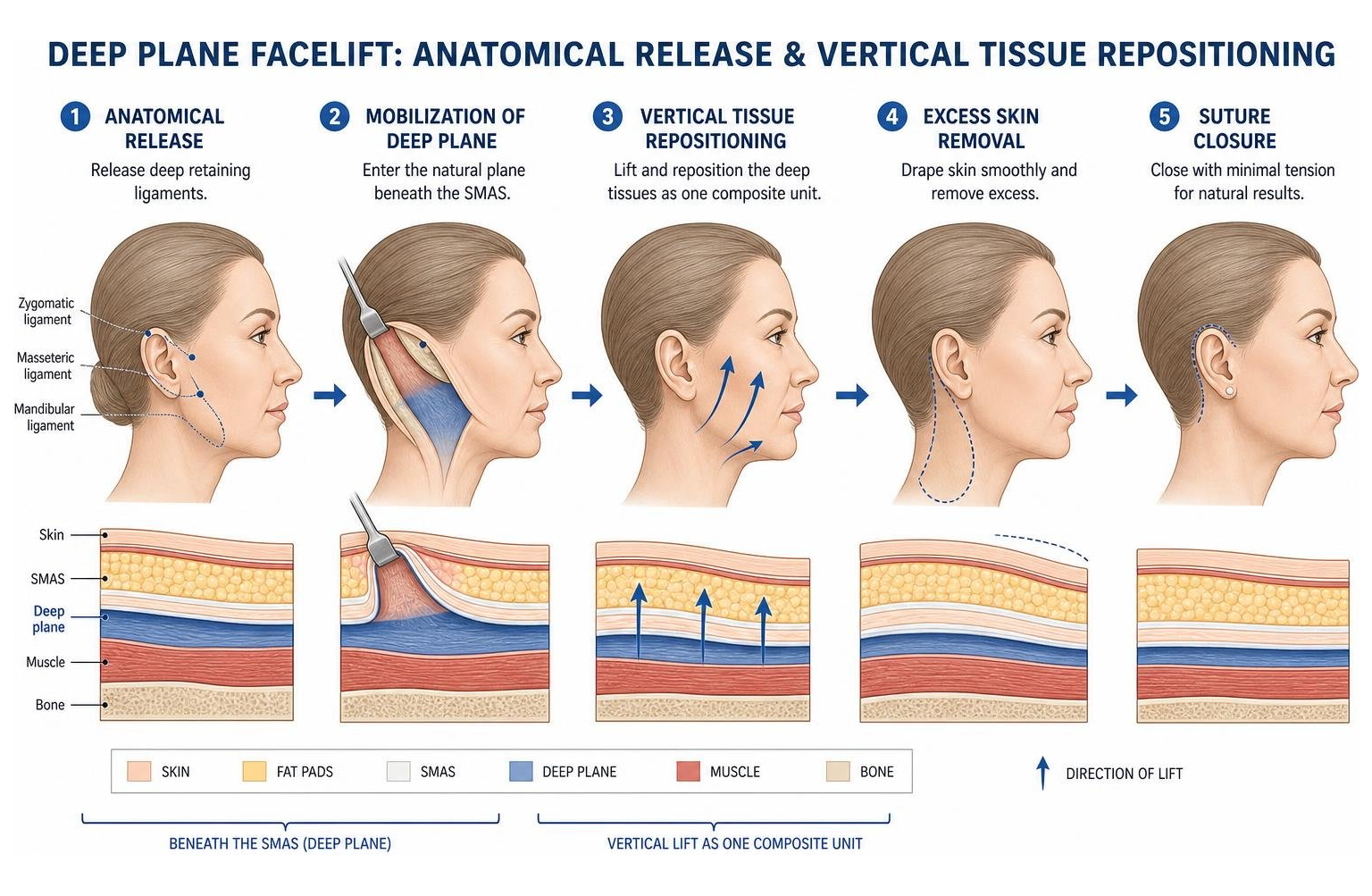
This approach offers several major advantages:
- Release of Retaining Ligaments: The deep plane technique allows us to safely release the deep zygomatic, masseteric, and mandibular retaining ligaments. Once these ligaments are released, the descended buccal and pre-mandibular fat pads and the platysma muscle can be lifted vertically as a single, cohesive “composite unit.”
- No “Pulled” Look: Because the skin and deep tissues remain attached, the face is lifted vertically against gravity rather than pulled horizontally back toward the ears. This creates an incredibly natural, refreshed appearance with zero tension on the skin.
- Preserved Blood Supply: Dissecting beneath the SMAS layer preserves the natural blood vessels supplying the skin. This leads to significantly less bruising, faster healing, and safer outcomes, particularly for male patients, whose thicker skin requires robust blood flow, and previous facelift patients.
- Longer-Lasting Results: While traditional SMAS facelifts last 5 to 7 years before the tissues begin to sag again, deep plane facelift results for jowl correction last 10 to 15 years on average, boasting a patient satisfaction rate exceeding 99%.
To explore the science behind this advanced technique, visit our specialized page on Deep Plane Facelift details.
Comparing Jowl Correction Methods: Surgical vs. Non-Surgical
For patients who are not ready for surgery, non-surgical alternatives can offer temporary improvement. However, it is vital to understand their limitations.
| Treatment Modality | How It Works | Longevity | Best For | Patient Satisfaction |
|---|---|---|---|---|
| Deep Plane Facelift | Releases deep ligaments, lifts fat and muscle vertically as a composite unit | 10 – 15 Years | Moderate to severe jowling, neck laxity | > 99% |
| Mini Facelift | Shorter incisions, tightens lower cheeks and early jowls | ~10 Years | Mild to moderate jowling, minimal neck laxity | High |
| Dermal Fillers (JOLT) | Camouflages jowls by adding volume to adjacent hollows (pre-jowl sulcus) | 6 – 18 Months | Mild, early-stage jowling | Moderate (70%) |
| Thread Lifts | Uses barbed sutures to physically lift skin | 12 – 18 Months | Mild laxity, temporary refresh | Moderate |
Non-Surgical Options: The JOLT Technique and Dermal Fillers
Can fillers actually fix jowls? The short answer is: they can camouflage them, but they cannot lift them.
One popular non-surgical approach is the JOLT (Jowl Lifting) technique. This method uses high-density hyaluronic acid fillers (like Restylane Lyft) placed deep on the jawbone. Instead of injecting filler directly into the sagging jowl itself, which is a critical mistake that actually makes the lower face look heavier and wider, the filler is strategically injected around the jowl.
By filling the hollow space in front of the jowl (the pre-jowl sulcus) and restoring volume to the chin and jaw angle, we create the optical illusion of a straight, continuous jawline. Clinical studies show that the mean JRS (Jawline Rating Scale) improved from 2.75 at baseline to 1.53 at 90 days after using this technique.
However, fillers require ongoing maintenance every 6 to 18 months. Over time, the cost of repeated large-volume injections (often requiring 5 to 10 mL of filler) can easily exceed the cost of a one-time surgical procedure, leading to “filler fatigue” and a puffy, over-filled lower face.
To learn more about the clinical efficacy and limitations of these injectables, read the Research on non-surgical jowl correction. If you are trying to decide whether surgery is the right step for your anatomy, see our insights on Can facelift surgery reduce jowl size?.
Recovery, Longevity, and Cost of Jowl Rejuvenation
Undergoing a surgical facelift is a life-changing decision, and knowing what to expect during recovery is key to a stress-free experience.
The Recovery Timeline
Most patients are pleasantly surprised to find that facelift recovery is far more comfortable than they anticipated.
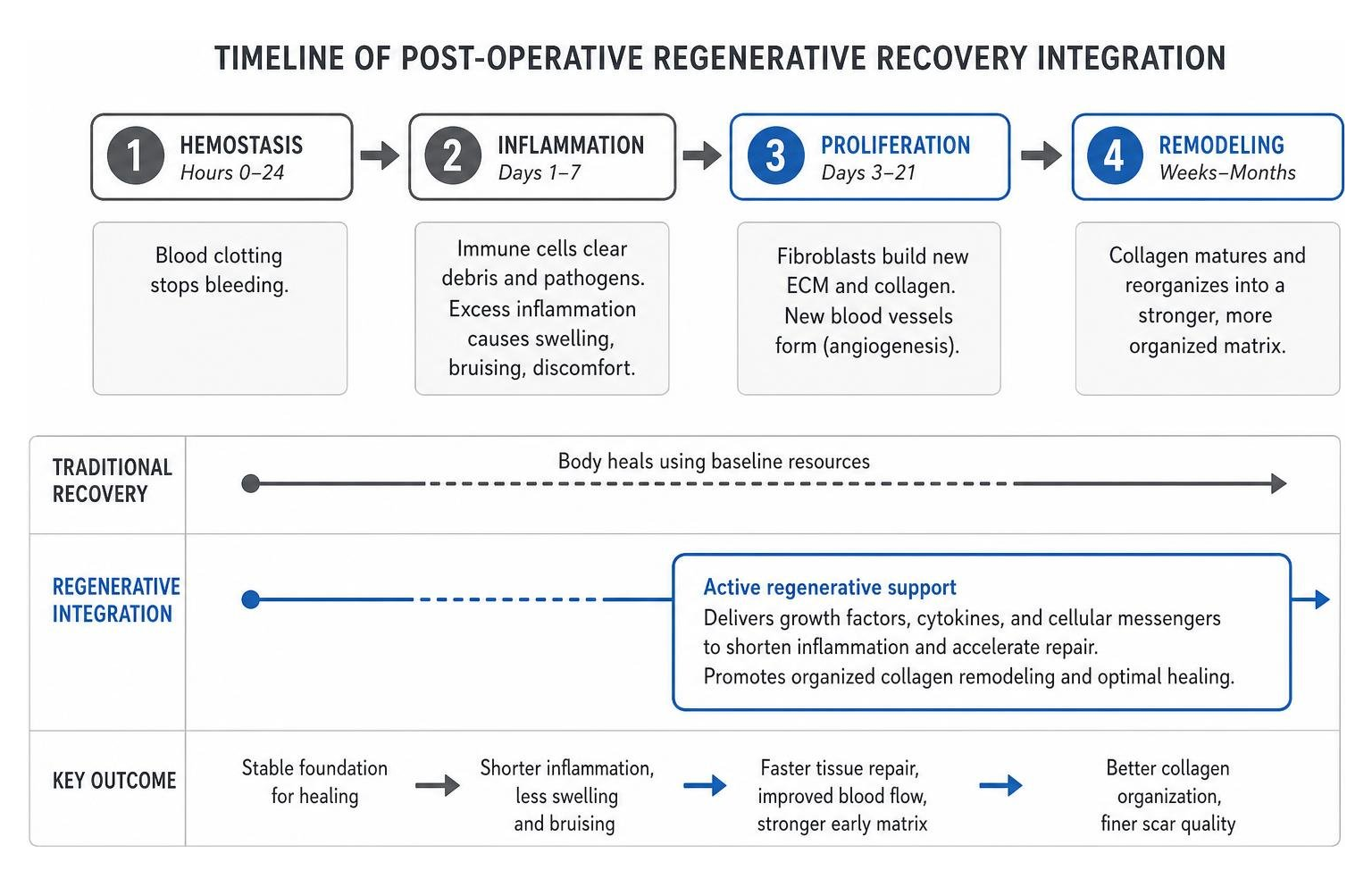
- Days 1–3: Swelling and bruising peak around 48 hours post-surgery. You will wear a soft, supportive facial wrap. Keeping your head elevated at a 45-degree angle (using a wedge pillow or sleeping in a recliner) is crucial during this phase to minimize swelling.
- Days 5–10: Sutures are carefully removed in our clinic. Swelling begins to resolve rapidly, and any remaining bruising can easily be camouflaged with makeup.
- Weeks 1–2: Most patients feel completely comfortable returning to work and light social activities.
- Weeks 4–6: You can safely resume strenuous exercise, heavy lifting, and vigorous physical activities. Your final, beautifully refined jawline contour will continue to emerge over the coming months.
Accelerating Healing with Regenerative Medicine
At Myint Oculo Facial Plastic Surgery, we specialize in integrating cutting-edge regenerative medicine into our surgical protocols to drastically reduce downtime and optimize scar healing. We often combine our deep plane facelifts with:
- Platelet-Rich Plasma (PRP): Using your body’s own growth factors to accelerate tissue repair and minimize bruising.
- Micro-Fat Grafting: Using highly purified fat cells to restore youthful volume to the midface and smooth fine wrinkles around the mouth, acting as a natural, permanent biostimulator.
- Hyperbaric Oxygen Therapy (HBOT): Breathing pure oxygen in a pressurized chamber pre- and post-surgery increases oxygen delivery to healing tissues, reducing swelling by up to 50% and speeding up recovery times significantly.
Cost of a Jowl Lift
The cost of a jowl lift varies based on the surgical technique used (mini vs. deep plane), the complexity of your anatomy, and geographic factors. In premier aesthetic markets like Beverly Hills, CA, and Las Vegas, NV, a standard facelift typically ranges from $11,050 to $15,450+, while highly specialized deep plane facelifts and comprehensive face-and-neck lifts can range higher due to the advanced expertise required.
Many patients wonder if they can address their jawline concerns with a neck lift alone. To understand how these procedures interact, read our guide: Will neck lift surgery get rid of my sagging jowls?.
Frequently Asked Questions about Jowl Correction
How long do jowl lift results typically last?
The longevity of your results depends heavily on the surgical technique. A deep plane facelift offers the longest-lasting results, typically keeping the jawline defined for 10 to 15 years. A mini facelift or standard SMAS facelift generally lasts around 10 years. While surgery effectively “turns back the clock” by a decade or more, your skin will continue to age naturally from that new, younger starting point.
What is the average cost of a jowl lift?
A surgical jowl lift (lower facelift) typically starts around $8,000 to $15,000+. This price can vary depending on whether you undergo a mini facelift or an extended deep plane facelift, as well as associated fees for the accredited surgical suite, board-certified anesthesiologist, and personalized regenerative therapies.
Can a neck lift alone fix sagging jowls?
A neck lift primarily addresses loose skin, muscle banding, and excess fat directly under the chin and neck. While a neck lift can slightly improve the look of the jawline, it cannot vertically lift descended facial fat pads. To fully correct sagging jowls, a lower facelift or deep plane facelift is almost always required in conjunction with neck contouring.
Conclusion
Saggy jowls are a natural, inevitable part of the aging process, but you do not have to live with a jawline that does not reflect how vibrant and youthful you feel on the inside.
At Myint Oculo Facial Plastic Surgery And Facial Regeneration, we believe in delivering results that look completely natural, elegant, and uniquely you. Dr. Myint’s rare dual-fellowship training in ophthalmic plastic reconstructive surgery and facial plastic surgery, combined with over two decades of expertise, allows us to seamlessly blend structural rejuvenation with advanced regenerative medicine.
Whether you are visiting our state-of-the-art clinics in Las Vegas, NV or Beverly Hills, CA, we are here to guide you every step of the way.
Ready to restore your sharp, youthful jawline? Schedule a Deep Plane Facelift consultation with us today.