

Droopy Eyes in 90210: Your Guide to Ptosis Repair and Deep Plane Facelifts
August 22, 2026
When Tired Eyes and a Sagging Face Tell the Wrong Story About You
If you’re exploring ptosis repair deep plane options in Beverly Hills, here’s what you need to know upfront:
| Question | Quick Answer |
|---|---|
| What is ptosis repair? | Surgery to lift a drooping eyelid by tightening the levator muscle, different from a simple skin removal (blepharoplasty) |
| What is a deep plane facelift? | An advanced facelift that repositions the deep structural layers of the face (SMAS + retaining ligaments), not just the skin |
| Can they be combined? | Yes, combining both procedures addresses the full face in one recovery period |
| Who performs this in Beverly Hills? | Dual-fellowship trained oculofacial plastic surgeons with expertise in both eyelid and deep facial anatomy |
| How long do results last? | Deep plane facelift results typically last 10–15 years; ptosis repair results are long-lasting because the muscle is physically tightened |
| What does recovery look like? | Most patients return to social activities within 10–14 days |
You might not notice it happening gradually. But one day, a photo stops you cold. Your upper eyelids hang heavier than you remember, your cheeks have shifted south, and your jawline has softened into something unfamiliar. You don’t look bad. You just look tired. And tired isn’t who you are.
This is one of the most common experiences among professionals in their 40s, 50s, and 60s. The face ages from the inside out. Muscles weaken, deep structural layers descend, and ligaments that once held everything in place slowly let go. No cream or injectable fully corrects this. Structure requires structural solutions.
That’s exactly why the combination of ptosis repair and a deep plane facelift has become one of the most sought-after approaches to comprehensive facial rejuvenation. It addresses the cause of aging, not just the surface symptoms.
I’m Dr. Shoib Myint, a board-certified, dual-fellowship trained Oculo Facial Plastic and Reconstructive Surgeon with over 20 years of experience and more than 15,000 surgeries performed, including the full spectrum of ptosis repair and deep plane facelift procedures in Beverly Hills. My dual-fellowship training means I operate with the precision of an oculoplastic specialist and the structural depth of a facial plastic surgeon, a rare combination that matters enormously when addressing both the eyes and the deeper face together.
The Gold Standard of Facial Rejuvenation: The Deep Plane Facelift
When it comes to reversing moderate to severe facial aging, we must look beneath the surface. For decades, traditional facelifts relied on pulling the skin tight over the underlying structures. While this temporarily smoothed out wrinkles, it often left patients with a “pulled,” “windswept,” or flat appearance. The modern golden standard has evolved far beyond this, aligning with advanced anatomical research supported by organizations like the National Institutes of Health.
To achieve a truly natural, refreshed look, we must operate at the foundation of the face. This is where the deep plane facelift shines.
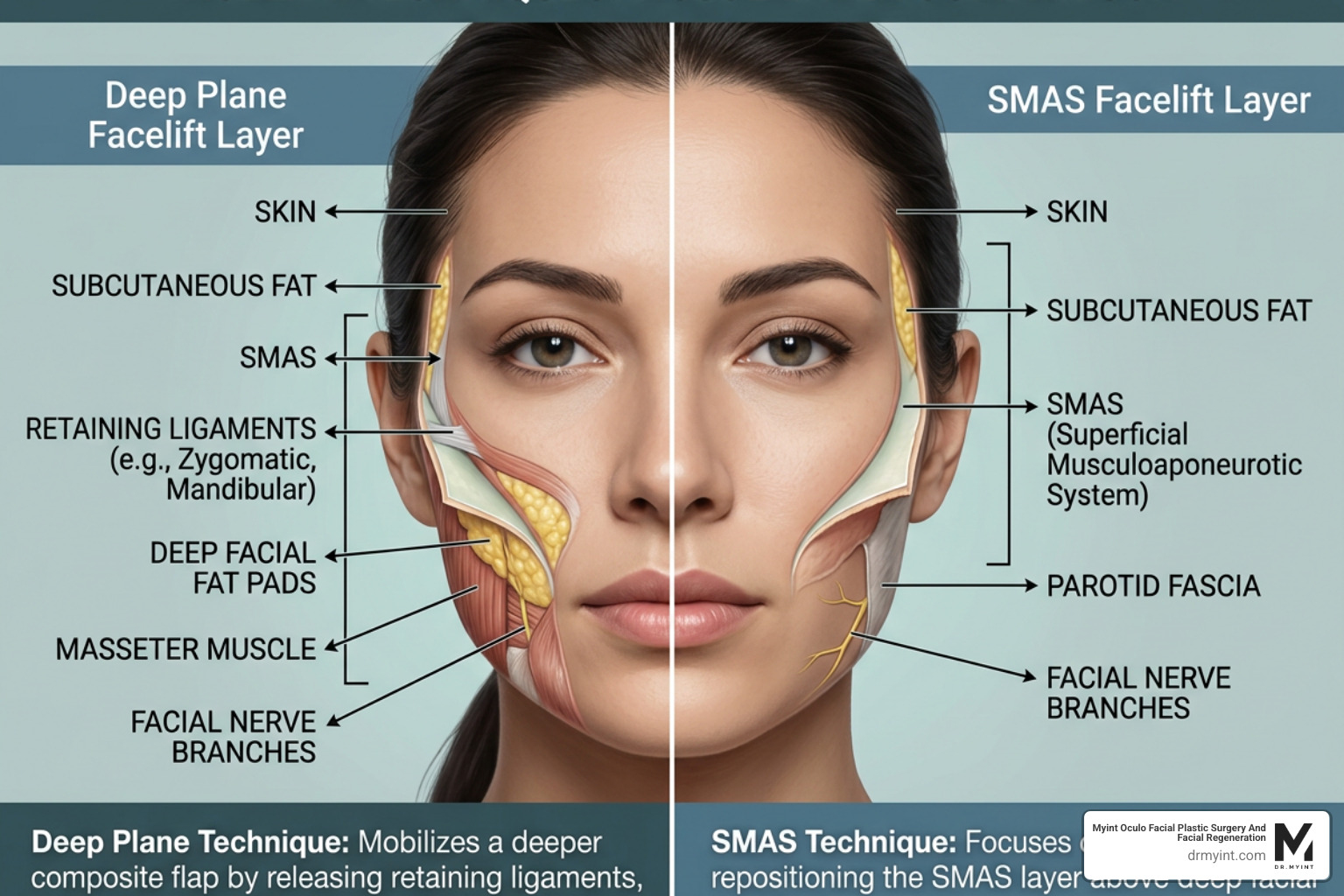
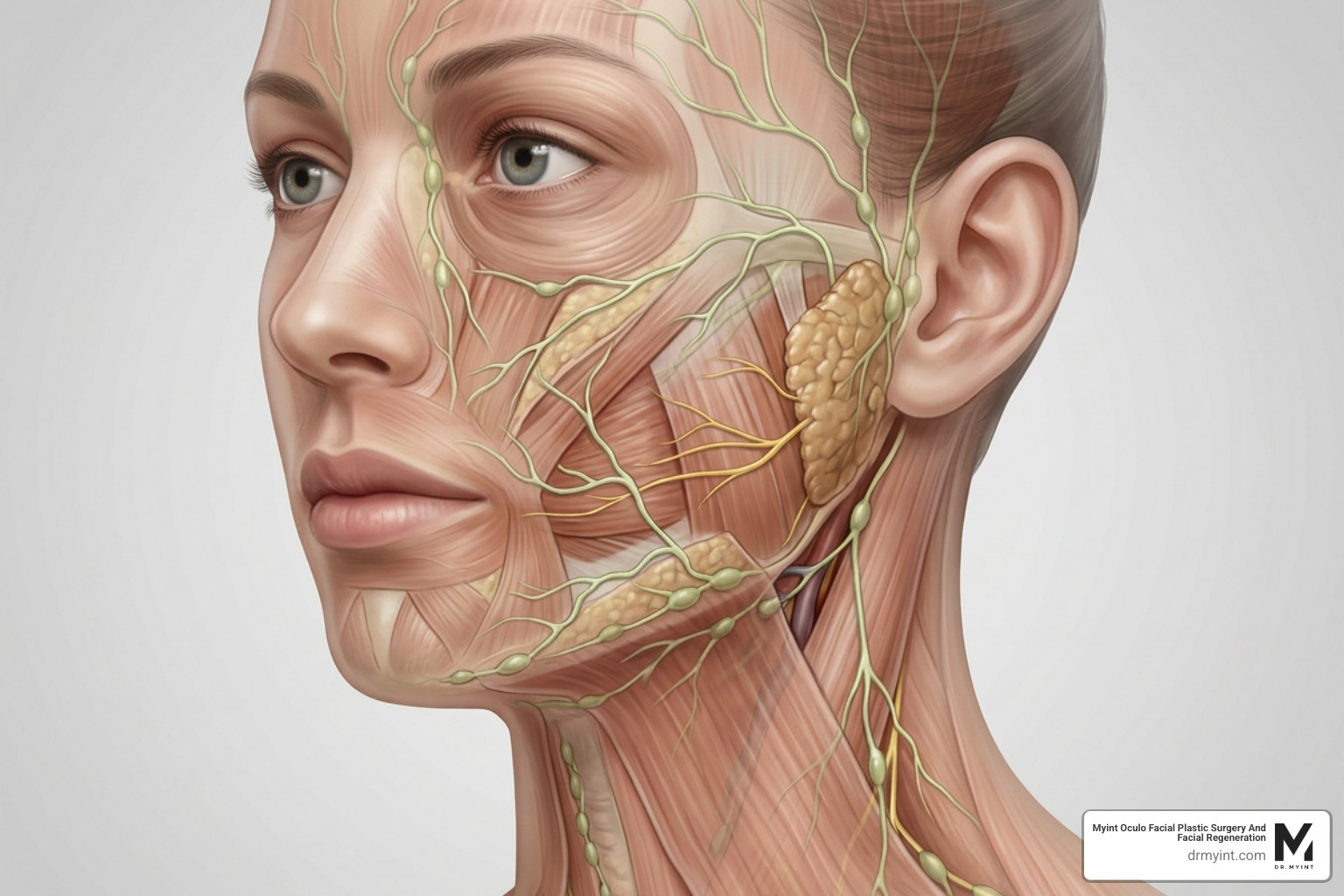
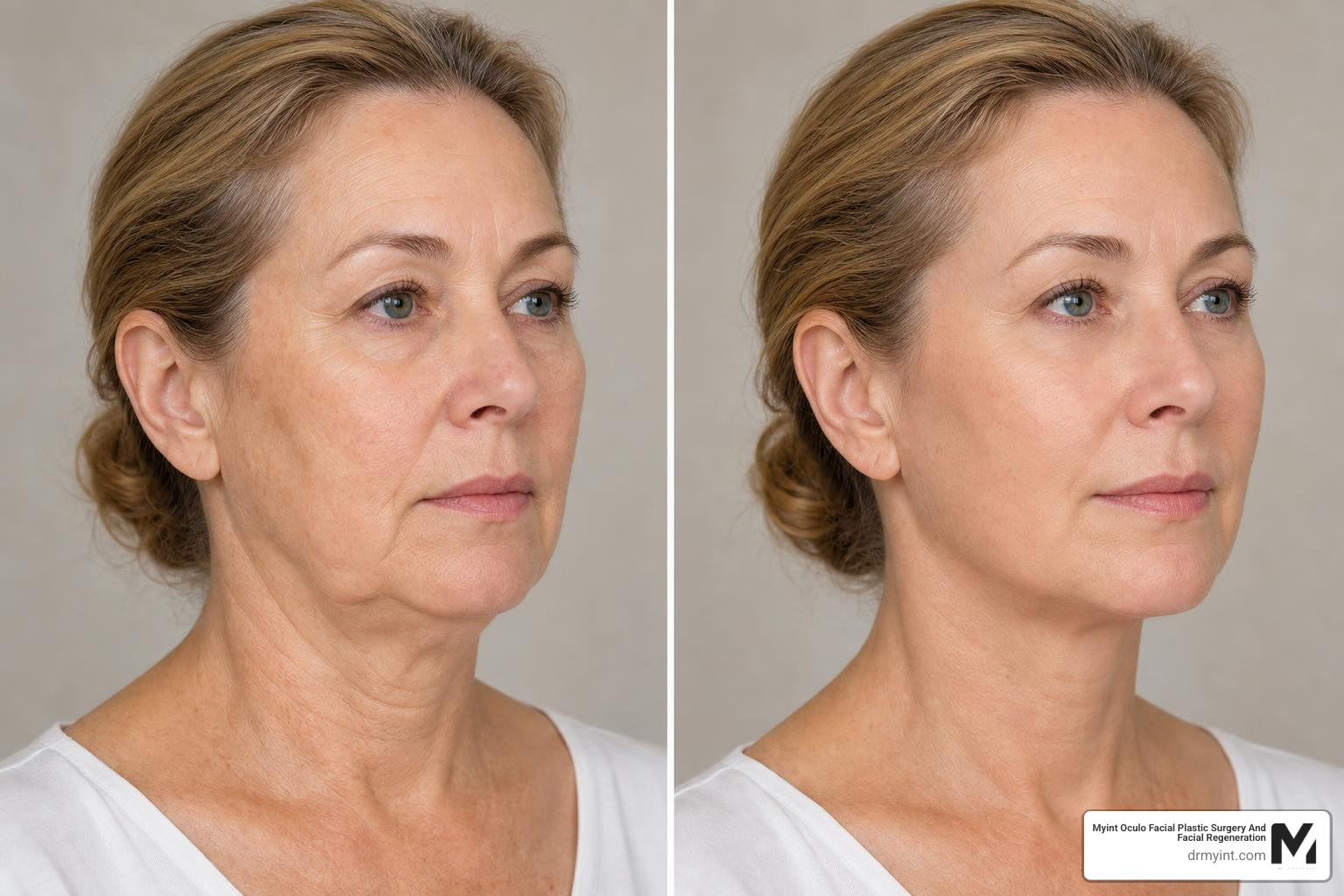
The deep plane facelift targets the Superficial Musculoaponeurotic System (SMAS), the fibrous, muscular layer of tissue that lies beneath the skin and subcutaneous fat. As we age, the SMAS layer stretches, and the deep retaining ligaments that anchor it to the underlying facial bones begin to slacken. This structural descent is what causes cheeks to hollow out, jowls to form along the jawline, and loose tissue to pool in the neck.
By entering the sub-SMAS space, we can release these restrictive retaining ligaments. Once released, the entire composite of muscle, fat, and skin can be lifted and repositioned as a single, tension-free unit. Because the tension is placed entirely on the deep structural tissues rather than the skin, the surface redrapes softly and naturally. This eliminates any risk of a “tight” look, ensures that surgical scars heal as thin, virtually invisible lines, and delivers a result that stands the test of time.
| Feature | Traditional SMAS Facelift | Deep Plane Facelift |
|---|---|---|
| Anatomical Target | Skin and superficial SMAS layer | Sub-SMAS space and deep retaining ligaments |
| Lifting Technique | Pulls skin and muscle separately (often horizontally) | Lifts skin, fat, and muscle together as a single unit (vertically) |
| Risk of “Pulled” Look | Higher, due to tension placed directly on the skin | Virtually none, as skin is redraped completely tension-free |
| Midface Rejuvenation | Limited; often requires secondary fillers or fat grafting | Excellent; naturally restores youthful cheek volume by lifting fallen tissue |
| Longevity of Results | Typically 7 to 10 years | Highly durable; typically 10 to 15+ years |
| Incision Healing | Can stretch or widen due to tension | Heals exceptionally well with minimal scarring |
How a Deep Plane Facelift Differs from a Regular Facelift
To understand why the deep plane approach is so highly regarded, it helps to look at the mechanics of the dissection. Many patients ask us: how does a deep plane facelift differ from a regular facelift?
In a standard or “regular” facelift, the surgeon separates the skin from the underlying muscle. The skin is pulled tight, excess skin is trimmed away, and the SMAS layer may be gathered, folded, or stitched (a technique known as SMAS plication). While this can improve the jawline, it does very little to address the midface or deep nasolabial folds because the deep anchoring ligaments remain intact. Furthermore, pulling the skin to lift the face puts tension on the incisions, which can lead to visible scarring or distortion of the earlobes.
In contrast, a deep plane facelift involves minimal separation of the skin from the SMAS. Instead, we enter the deeper plane beneath the SMAS layer. By dissecting in this naturally occurring, bloodless plane, we can directly release the key retaining ligaments (such as the zygomatic and masseteric ligaments). This allows us to lift the heavy tissues of the midface, jowls, and neck vertically, returning them to the position they occupied a decade or more ago. The skin is simply allowed to follow this deep structural lift, resulting in a beautifully soft, authentic restoration.
The Role of SMAS and Retaining Ligaments in Facial Aging
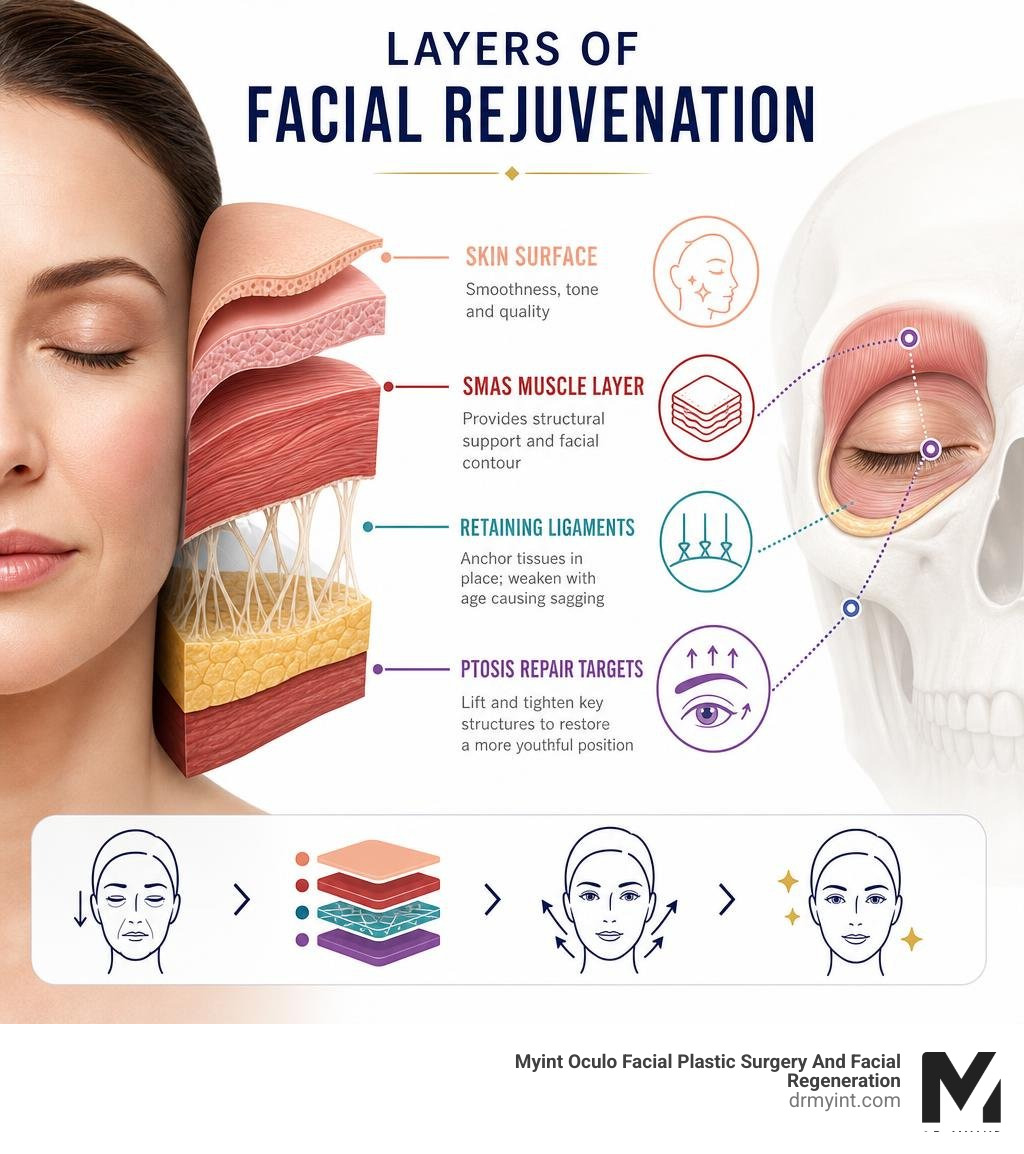
To visualize how facial aging occurs, think of your facial anatomy as a multi-layered house. The bones are the foundation, the retaining ligaments are the heavy-duty structural pillars, the SMAS and deep fat pads are the framing, and your skin is the exterior siding.
Over time, gravity and the natural loss of collagen and elastin cause the structural pillars (the retaining ligaments) to stretch and sag. When these pillars give way, the framing (the SMAS and fat pads) slides downward. This tissue descent manifests as:
- Hollowed Cheeks: The youthful, high-volume fat pads of the midface slide downward and inward, leaving the under-eye area looking hollow and tired.
- Deep Nasolabial Folds and Marionette Lines: The descending cheek tissue pools against the fixed muscles around the mouth, creating deep creases.
- Jowls: Sagging tissue spills over the jawline, disrupting a crisp, clean profile.
- Neck Laxity: The platysma muscle in the neck separates and sags, creating “bands” and a loss of the youthful chin-to-neck angle.
By surgically releasing the retaining ligaments, we free the descended SMAS. We can then slide this entire layer back up to its youthful home, naturally restoring volume to the cheeks and smoothing out the lower face without the need for synthetic fillers.
Addressing the Upper Face: Ptosis Repair and Eyelid Rejuvenation
While a deep plane facelift restores the structural foundation of the midface and jawline, comprehensive rejuvenation sometimes requires a subtle adjustment to the upper face. For patients with sleepy or heavy-looking eyes, the issue is often medical: upper eyelid ptosis, where the eyelid margin sits too low.
It is important to understand ptosis surgery vs blepharoplasty how are they different. While a standard blepharoplasty simply trims excess skin, ptosis repair is a precise procedure that tightens the underlying levator muscle to lift the eyelid margin itself.
Whether performed through an external crease incision or an internal, scarless approach, this targeted adjustment opens up the eyes. By keeping this procedure highly focused, we ensure it serves as a complementary touch to the primary structural lifting of the deep plane facelift.
The Synergy of Combined Procedures: Ptosis Repair and Deep Plane Facelift
Why do we so frequently combine these two advanced procedures? The answer lies in the concept of facial harmony.
If you undergo a deep plane facelift that beautifully lifts your cheeks, jawline, and neck, but your upper eyelids remain heavy, droopy, and sleepy-looking, the overall aesthetic result can feel disjointed. Conversely, fixing droopy eyelids without addressing a sagging lower face can draw unwanted attention to the aging jawline and neck.
By combining ptosis repair with a deep plane facelift, we address periorbital aging and lower face sagging simultaneously. This unified approach ensures that the upper, middle, and lower portions of your face age in perfect harmony, presenting a refreshed and completely natural version of yourself to the world.
This is the essence of the ptosis repair deep plane beverly hills philosophy. Performing these procedures together is not only highly efficient, allowing you to undergo a single surgical preparation, one anesthesia session, and a single, consolidated recovery period, but it also allows us to coordinate the structural lifting of the midface with a deep plane eyelid lift to seamlessly blend the transition between the lower eyelid and the cheek.
Advanced Healing: Regenerative Medicine and Hyperbaric Oxygen in Facelift Recovery
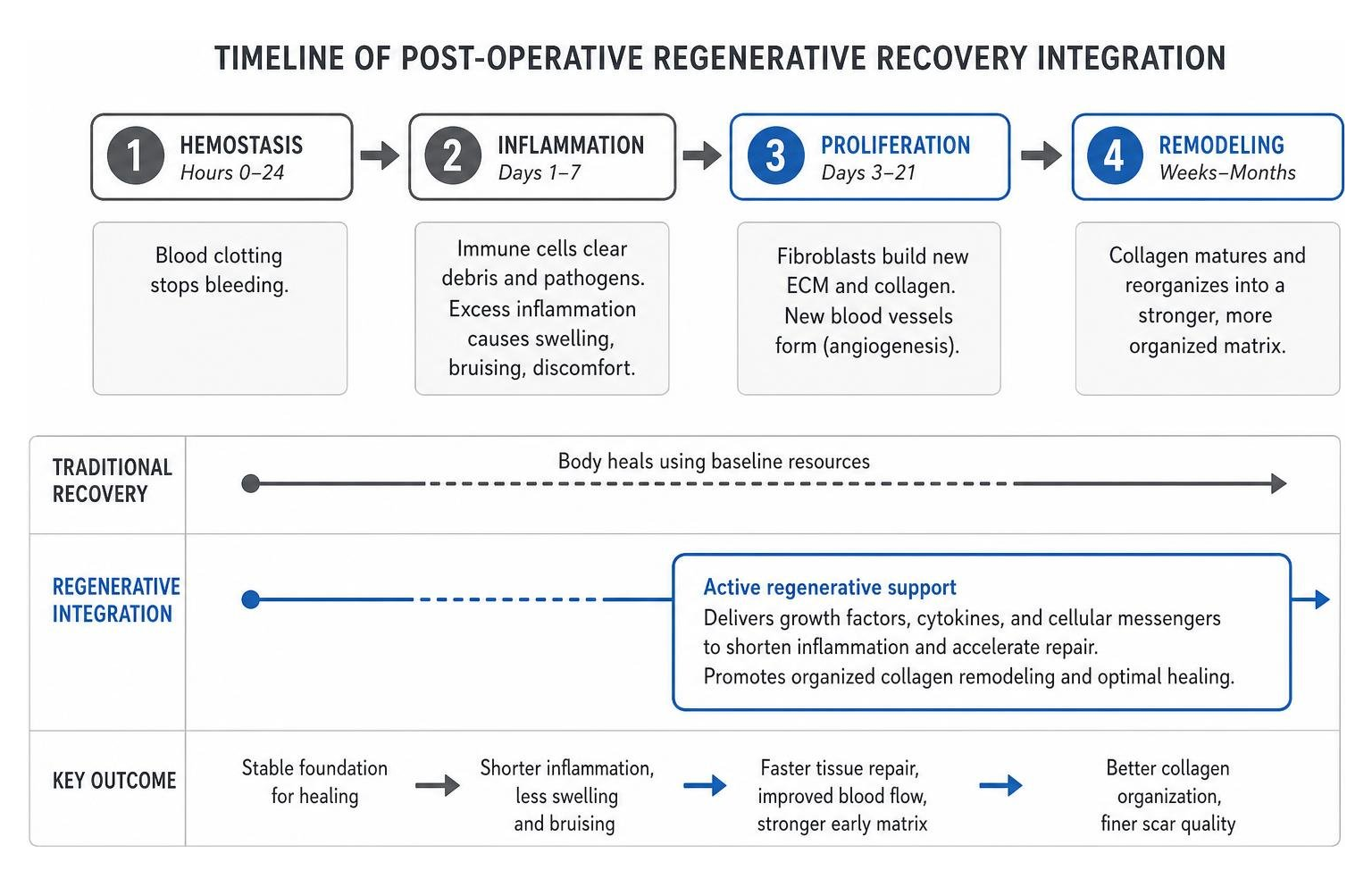
At our practice, we believe that exceptional surgery is only half of the equation. The other half is how we help your body heal. Because we specialize in regenerative facial procedures, we incorporate advanced cellular therapies and healing modalities into every surgical plan to accelerate your recovery, minimize downtime, and optimize your final results.

Micro and Nano Fat Grafting for Midface Volumization
While a deep plane facelift physically repositions descended tissues, the natural aging process also involves a loss of deep structural fat. To address this structural deflation, we frequently perform a micro nano fat facelift in conjunction with the surgical lift.
Using gentle liposuction, we harvest a small amount of your own fat (typically from the abdomen or thighs). This fat is then highly purified and processed:
- Micro-fat: Larger fat particles used to restore deep structural volume to areas like the temples, cheeks, and piriform aperture (around the base of the nose).
- Nano-fat: Highly filtered, liquid-like fat that is rich in regenerative adipose-derived stem cells (ADSCs) and growth factors. We inject nano-fat superficially into the skin and delicate periorbital tissues to improve skin texture, soften fine lines, erase dark circles, and promote tissue regeneration at a cellular level.
Hyperbaric Oxygen Therapy (HBOT) for Rapid Recovery
To further accelerate the recovery process, we utilize Hyperbaric Oxygen Therapy (HBOT). During HBOT, you relax in a specialized chamber where you breathe 100% pure oxygen at increased atmospheric pressure.
This treatment floods your bloodstream and tissues with oxygen, which:
- Reduces post-operative swelling and inflammation quickly.
- Promotes rapid angiogenesis (the formation of new blood vessels) to support the lifted tissues.
- Accelerates wound healing at incision sites, ensuring scars fade as quickly as possible.
- Dramatically reduces bruising, helping you return to your social and professional life in Beverly Hills in record time.
Frequently Asked Questions About Deep Plane Facelifts and Ptosis Repair
Is a deep plane facelift better than a traditional facelift for long-term results?
Yes. When patients ask us is a deep plane facelift better than traditional techniques, the answer lies in the longevity and natural appearance of the results. Because a deep plane facelift releases the deep anchoring ligaments and repositions the heavy SMAS layer without placing any tension on the skin, the results are incredibly durable. While a traditional facelift may start to show signs of relaxation after 7 to 10 years, a deep plane facelift typically keeps you looking refreshed and rejuvenated for 10 to 15+ years.
Can ptosis repair and a deep plane facelift be performed under local anesthesia?
Absolutely. While many surgeons perform these complex procedures under general anesthesia, we are highly experienced in performing both deep plane facelifts and delicate eyelid surgeries under local awake anesthesia with light twilight sedation. This approach is exceptionally safe, eliminates the systemic risks and post-operative nausea associated with general anesthesia, and allows for real-time assessment of eyelid symmetry during the ptosis repair.
What is the typical recovery timeline for combined facial rejuvenation?
Most patients are pleasantly surprised by how manageable the recovery is. While a deep plane facelift is a major procedure, operating in the natural, sub-SMAS plane results in significantly less bleeding, bruising, and pain than traditional methods.
- Days 1–3: Peak swelling. We recommend resting with your head elevated and utilizing cold compresses.
- Days 5–7: Stitches are gently removed at our office. Most bruising begins to fade.
- Days 10–14: Most patients feel comfortable returning to work and light social activities. Any residual swelling can easily be concealed with light makeup.
- Weeks 4–6: You can resume strenuous exercise, and the beautiful, refined contours of your jawline and eyes will become increasingly apparent.
Choosing Your Dual-Fellowship Surgeon in Beverly Hills
Your face is your calling card, and the delicate tissues of the eyelids and deep face require an artist’s touch and a specialist’s hand.
At Myint Oculo Facial Plastic Surgery And Facial Regeneration, we provide a level of expertise that is exceedingly rare. As a dual-fellowship trained surgeon, I have spent over two decades mastering both the intricate, microscopic anatomy of the eyes and the deep structural pathways of the face. Our practice specializes in combining advanced surgical techniques like the deep plane facelift with regenerative therapies to deliver results that are both transformative and completely natural.
If you are ready to restore clarity to your gaze and youthful definition to your face, we invite you to visit our beverly hills office for a personalized, comprehensive consultation. Let us help you look as vibrant, energetic, and refreshed as you feel.
Schedule a Consultation for Ptosis Repair with us today.