

Eyelid Surgery Anesthesia Options to Keep You Calm and Comfortable
July 29, 2026
Why Your Anesthesia Choice Matters More Than You Think
The blepharoplasty anesthesia type options available to you can shape your entire surgical experience — from how comfortable you feel in the chair to how quickly you’re back to normal life.
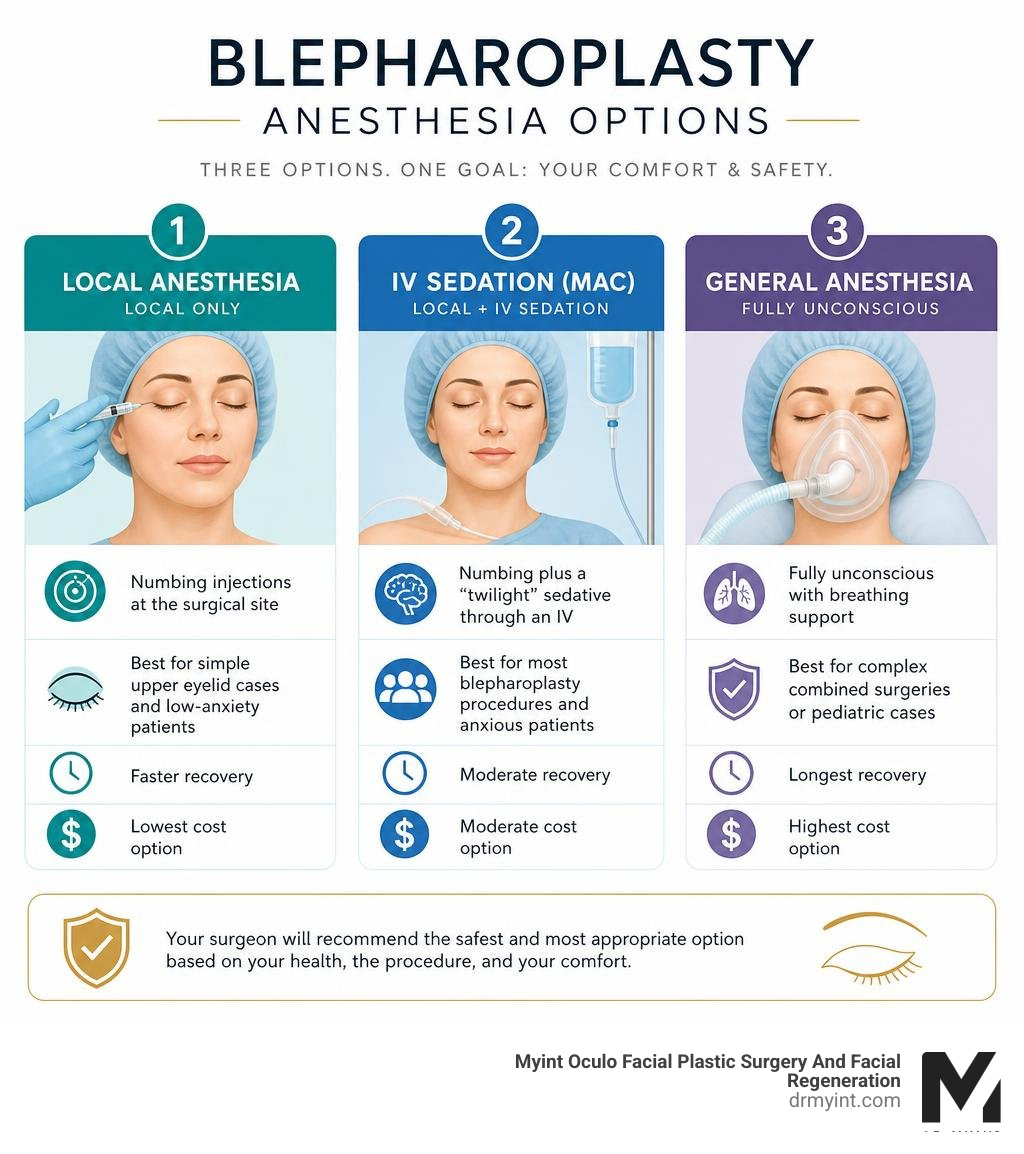
Here’s a quick overview of the three main options:
| Anesthesia Type | What It Is | Best For |
|---|---|---|
| Local only | Numbing injections at the surgical site | Simple upper eyelid cases, low-anxiety patients |
| Local + IV sedation (MAC) | Numbing plus a “twilight” sedative through an IV | Most blepharoplasty procedures, anxious patients |
| General anesthesia | Fully unconscious, breathing tube | Complex combined surgeries, pediatric cases |
Most eyelid surgeries use local anesthesia with or without IV sedation. General anesthesia is reserved for specific situations — like procedures combined with deep facial surgery, or children who cannot remain still.
Each option carries a different safety profile, recovery time, and cost. The right choice depends on your health history, anxiety level, and what your surgeon plans to do.
This guide walks you through all three options in plain language so you can have a more confident conversation at your pre-operative visit.
Understanding Your Blepharoplasty Anesthesia Type Options
When preparing for an eyelid lift (blepharoplasty) at our Beverly Hills or Las Vegas locations, one of the most common questions we hear is, “Am I going to be completely asleep?” The short answer is: you don’t necessarily have to be. In fact, for the vast majority of patients, avoiding the heavy grogginess of general anesthesia is not only possible but highly preferred.
To help you understand the landscape of blepharoplasty anesthesia type options, let’s look at how these methods compare across safety, facility time, and patient experience:
| Comparison Metric | Local Anesthesia Alone | Conscious Sedation (IV MAC / Twilight) | General Anesthesia |
|---|---|---|---|
| Consciousness Level | Fully awake, completely numb | Sleepy, relaxed, responsive but drifting | Completely unconscious |
| Airway Control | Self-breathing | Self-breathing | Breathing tube & ventilator |
| Average Facility Time | 2 to 3 hours | 3 to 4 hours | 4 to 5+ hours |
| Typical Recovery Time | Immediate (walk out) | 15–30 mins to wake up; 24-hr rest | 1–2 hours to wake up; lingering grogginess |
| Best Suited For | Isolated upper lids, high medical risk | Upper & lower lids, moderate anxiety | Combined facial surgeries, high anxiety |
The clinical guidelines outlined in Anesthesia for Oculoplastic Surgery – EyeWiki highlight that the choice of anesthesia depends heavily on the specific procedure, patient health, and surgeon preference. Because the eyelids are highly vascularized and sensitive, we customize the anesthesia plan to ensure your safety and comfort.
- Local Anesthesia: This is the default starting point for many isolated eyelid procedures. We inject a localized numbing agent (typically lidocaine with epinephrine) directly into the eyelid tissue. While you remain fully awake, you will not feel any pain.
- Conscious Sedation (Twilight Anesthesia): This method combines local numbing with intravenous (IV) medications to induce a dream-like state of relaxation. Known as Monitored Anesthesia Care (MAC), you remain breathing on your own without a breathing tube.
- General Anesthesia: This is the deepest level of anesthesia, where you are completely unconscious and require a breathing tube. While highly effective, it is usually reserved for complex, multi-procedure surgeries.
Comparing Blepharoplasty Anesthesia Type Options for Upper vs. Lower Lids
The choice of anesthesia often changes depending on whether we are treating your upper eyelids, lower eyelids, or both.
Upper blepharoplasty is relatively straightforward. Because it primarily involves removing excess skin and small pockets of fat from the surface, it is easily performed under local anesthesia alone or with mild oral sedation.
Lower blepharoplasty, however, is a different anatomical ballgame. It often requires a trans-conjunctival approach (an incision made on the inside of the lower lid) to remove or reposition fat pads, or a subciliary incision just below the eyelashes. Because manipulating the lower lid can feel slightly more invasive and cause a mild pulling sensation, we typically recommend twilight (IV MAC) sedation. This ensures you remain completely comfortable and still while we work.
For patients seeking a Blepharoplasty Surgeon Near Me Las Vegas, we also look closely at whether the procedure is a primary surgery or a revision. Revision blepharoplasty often involves navigating delicate scar tissue from a previous procedure, which requires meticulous, slow dissection. For revision cases, having the patient under IV sedation or local anesthesia is incredibly beneficial because it allows us to ask you to open and close your eyes during the procedure to verify symmetry and proper eyelid function in real time.
How Patient Health Dictates Blepharoplasty Anesthesia Type Options
Your medical history is the ultimate compass directing our anesthesia choice. During your consultation with a qualified Blepharoplasty Surgeon Nevada, we will perform a comprehensive medical review.
- Anxiety Levels: High anxiety can cause your blood pressure to spike during surgery under local anesthesia alone. If the thought of being awake makes your heart race, conscious sedation is an excellent middle ground to keep you calm and physically stable.
- Sleep Apnea: If you use a CPAP machine for sleep apnea, deeper sedation requires careful planning. Heavy IV sedation can suppress your respiratory drive. For severe sleep apnea, we may recommend local anesthesia alone or a very light, highly monitored twilight sedation to keep your airway completely safe.
- Anticoagulants: Medications like aspirin, warfarin, or newer blood thinners must be reviewed. While local anesthesia is safe, elevated blood pressure during surgery can increase bleeding risks, making hemodynamic stability (which we achieve through targeted sedation) highly important.
Comparing Local, Sedation, and General Anesthesia
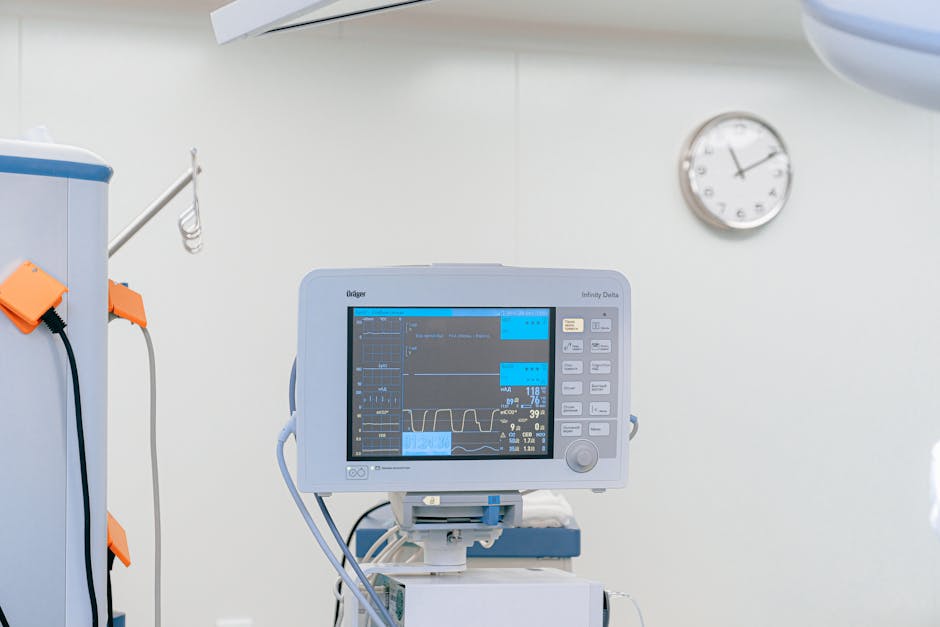
Choosing the right anesthesia is a balancing act between safety, comfort, and recovery speed. Let’s break down the three primary blepharoplasty anesthesia type options in detail.
Clinical data published in Conscious Sedation Methods for Blepharoplasty in Day Surgery shows that choosing conscious sedation over general anesthesia significantly improves the patient experience by minimizing post-operative nausea, reducing the risk of respiratory complications, and offering a much faster return to daily activities.
Local Anesthesia Alone
Local anesthesia is the safest, most direct method for isolated eyelid surgery. We inject a localized cocktail — usually lidocaine for rapid numbing, bupivacaine (Marcaine) for long-lasting pain control, and epinephrine. Epinephrine is a vasoconstrictor, meaning it temporarily shrinks blood vessels in the area to minimize bleeding and bruising.
- The Experience: You are fully awake and can chat with our surgical team. You will feel a brief pinch and a mild warm sensation during the initial injection, but within minutes, the entire eyelid area becomes completely numb.
- Pros: Lowest systemic risk, no post-operative grogginess, and zero fasting requirements before surgery. You can typically leave our facility within 2 to 3 hours of arrival.
- Cons: You remain fully aware of your surroundings, which may not be ideal if you struggle with medical anxiety.
If you are trying to understand how different eyelid procedures work, reading up on Ptosis Surgery vs Blepharoplasty How Are They Different can help clarify why local anesthesia is so popular for these precise, functional adjustments.
Conscious Sedation (Oral vs. IV MAC)
Conscious sedation, often referred to as “twilight anesthesia,” is the sweet spot for most of our patients in Beverly Hills and Las Vegas. It can be administered in two ways:
- Oral Sedation: You swallow a prescription pill (such as diazepam) about an hour before surgery. This takes the edge off your anxiety, making you feel pleasantly drowsy and relaxed while we administer the local numbing injections.
- IV Sedation (Monitored Anesthesia Care / MAC): An anesthetist administers a tailored mix of medications (such as midazolam, fentanyl, or dexmedetomidine) through an IV line.
According to a review on Anesthesia for office‐based facial plastic surgery procedures – PMC, conscious sedation using medications like dexmedetomidine (Precedex) provides excellent hemodynamic stability. This means your blood pressure and heart rate remain smooth and steady, which directly reduces your risk of bruising and minor hematomas after surgery. Furthermore, dexmedetomidine has been shown to cause significantly fewer episodes of hypoxia (low oxygen levels) compared to conventional sedation drugs.
General Anesthesia
General anesthesia is a state of controlled, temporary unconsciousness. An anesthesiologist administers gases and intravenous drugs to put you completely “under,” and a breathing tube is placed to manage your airway.
While general anesthesia is rarely necessary for a standalone eyelid lift, it is highly valuable in specific scenarios:
- Combined Facial Procedures: If we are combining your blepharoplasty with a deep plane facelift, brow lift, or rhinoplasty, general anesthesia ensures your airway is fully protected during a longer surgery.
- Pediatric Cases: Children undergoing reconstructive eyelid or ptosis surgery cannot remain still and require general anesthesia for their safety.
- Inability to Cooperate: Patients with severe involuntary tremors or extreme phobias may require complete unconsciousness.
Administration Techniques and Minimizing Discomfort

At our practice, we believe that the journey to beautiful, refreshed eyes shouldn’t begin with a stressful or painful experience in the operating room. We utilize advanced, gentle administration techniques to make the numbing process as comfortable as possible.
As detailed in Local anesthesia and anxiolytic techniques for oculoplastic surgery, several non-pharmacological and pharmacological interventions can dramatically reduce the discomfort associated with local anesthetic injections.
Minimizing Injection Pain
The “sting” of a local anesthetic injection is actually caused by the acidic pH of the lidocaine. To combat this and ensure a gentle experience, we employ several comfort-focused techniques:
- Buffering with Sodium Bicarbonate: By mixing a tiny amount of sodium bicarbonate with the lidocaine, we neutralize the acid. This eliminates the classic burning sensation, leaving you with only a mild, brief pinch.
- Warming the Anesthetic: Cold liquid injected into warm body tissue causes discomfort. We warm our local anesthetics to body temperature prior to injection to make the transition seamless.
- Ultra-Fine 30-Gauge Needles: We use needles that are as thin as a strand of hair to minimize physical sensation.
- Vibration Anesthesia: Based on the “Gate Control Theory” of pain, we apply a gentle, high-frequency vibrating device to your cheek or forehead during the injection. The brain processes the pleasant vibration signal first, effectively blocking the pain signals from reaching your awareness. Studies show this can reduce perceived injection pain by over 50%!
Regional Nerve Blocks and Diffusion
To minimize the number of needle sticks around your delicate eyelids, we often utilize regional nerve blocks rather than widespread tissue infiltration.
By target-injecting near the main sensory nerves — such as the supraorbital nerve above the eye or the infraorbital nerve below the cheek — we can numb the entire upper or lower eyelid with a single, precise injection.
According to Local and Regional Anesthesia in Ophthalmology and Ocular Trauma – StatPearls – NCBI Bookshelf, regional nerve blocks prevent local tissue distortion. This is highly beneficial because injecting large volumes of fluid directly into the eyelid can puff up the skin, making it harder for the surgeon to judge precise symmetry. Nerve blocks keep the tissue natural and flat, allowing for highly accurate surgical tailoring.
We also use the Digital Diffusion Technique. We inject a small, highly concentrated amount of anesthetic laterally, and then gently massage and diffuse the fluid medially with a gloved hand. This minimizes needle sticks, reduces the risk of bruising, and ensures a uniform block.
Frequently Asked Questions About Eyelid Surgery Anesthesia
Choosing your anesthesia can raise a lot of practical questions. When researching How to Find a Good Blepharoplasty Surgeon, finding a team that takes the time to answer these concerns pre-operatively is a key sign of high-quality care.
Will the local anesthetic injection hurt?
You will feel a brief, mild pinch as the ultra-fine needle enters the skin, followed by a slight stretching sensation as the numbing fluid spreads. To make this as easy as possible, we apply a clinical-strength topical numbing cream to your eyelids 30 to 45 minutes before the procedure, which significantly dulls the surface of the skin. Most patients find the sensation much easier to tolerate than a routine dental injection.
What if I move or sneeze during surgery under local anesthesia?
This is a very common worry! First, because the local anesthetic completely blocks pain, you won’t have any sudden, painful reflexes that make you jump. If you feel a sneeze, cough, or itch coming on, simply give us a quick verbal warning. Our surgical team will pause, secure the area, let you get the sneeze out, and then resume safely when you are settled.
Is anesthesia billed as part of my surgical fee?
This depends on your chosen blepharoplasty anesthesia type options:
- Local Anesthesia: When performed in-office under local anesthesia alone, the numbing is typically included in your surgical fee.
- IV Sedation and General Anesthesia: Because these require a certified anesthesiologist or nurse anesthetist to monitor your vitals, as well as specialized surgical facility space, they involve separate, time-based billing for the anesthesia provider and the facility. We will always provide a clear, written breakdown of all fees before your procedure.
Conclusion
At Myint Oculo Facial Plastic Surgery And Facial Regeneration, we believe that a successful eyelid lift is built on both exquisite surgical results and a stress-free, comfortable experience.
Dr. Myint’s rare dual fellowship training and over 20 years of expertise in regenerative facial procedures allow our team to design highly customized surgical and anesthetic plans. Whether you choose the simple ease of local anesthesia or the deep relaxation of twilight IV sedation, our state-of-the-art facilities in Las Vegas, NV, and Beverly Hills, CA, are fully equipped to keep you safe and comfortable every step of the way.
Ready to take the next step toward refreshed, youthful eyes? More info about eyelid lift services is just a click away. Schedule a personalized consultation with us today to discuss your goals and find the perfect anesthesia plan for your peace of mind.